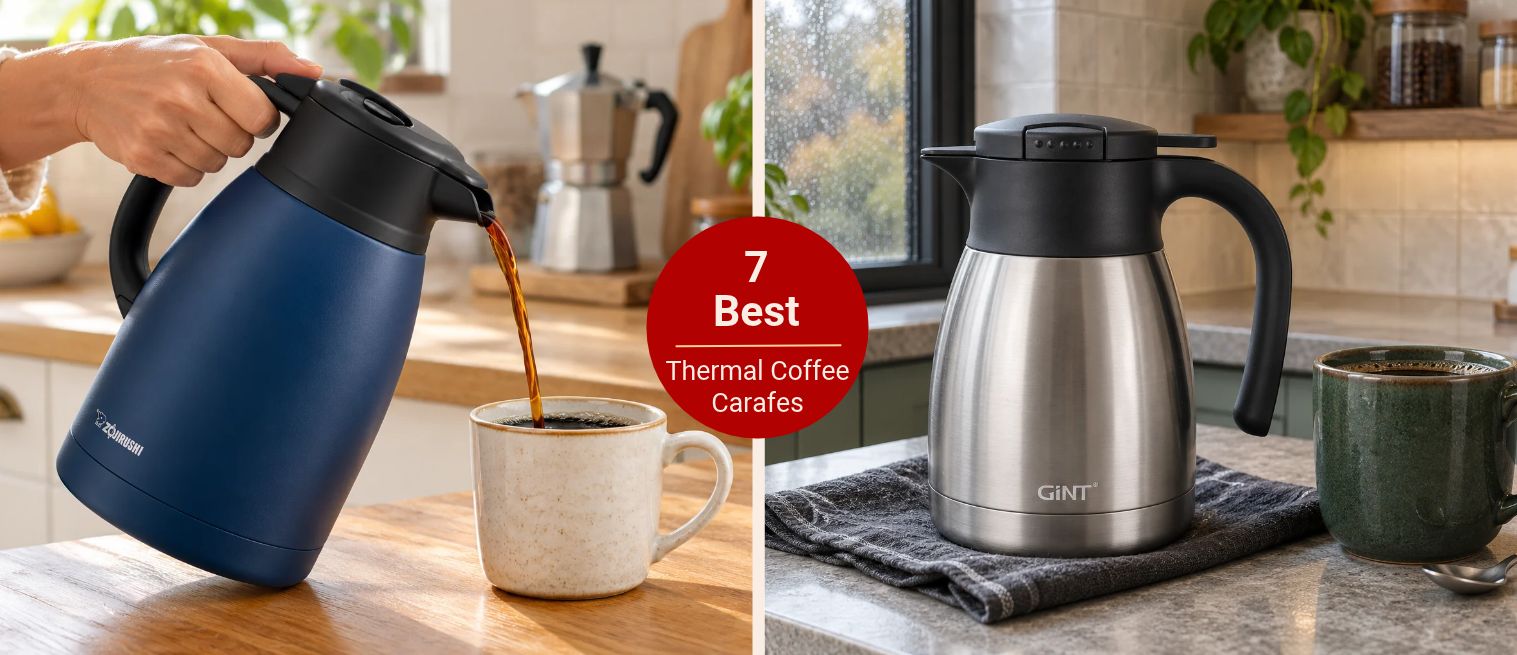
7 Best Thermal Coffee Carafes for Keeping Coffee Hot
Last updated on October 23rd, 2026 at 02:57 pm
Have you ever made a full pot of coffee, enjoyed the first cup, and returned later to find the rest already cold?
Now that Autumn is here, and sooner or later Winter, it is time to find better ways to keep our coffee warm. Although the beginning of fall can still surprise us with a welcoming warm day, which is when keeping something cold becomes useful too.
I really love Autumn. The weather cools down, the house feels quieter, and making another cup of coffee starts to feel like a good idea again.
The only problem is that my allergies always seem to hit me hard around this time. Some mornings, I make coffee and then become distracted looking for tissues.
By the time I return, the cup is not quite what it was.
A thermal carafe gives you somewhere to keep a larger batch without leaving it on a warming plate, where the coffee can slowly start tasting cooked.
But the biggest carafe is not automatically the best one. Someone making two cups of pour-over coffee needs something very different from a family serving breakfast or an office filling mugs all morning.
In this guide to the best thermal coffee carafes, I’ll compare seven options for different batch sizes, kitchens, and coffee routines.
Quick Comparison: Which Thermal Coffee Carafe Should You Buy?
The right choice mostly depends on how much coffee you make and where you plan to serve it. Here is the quick version before we look at each one more closely.
| Capacity | Roughly how many 8 oz mugs? | Best use |
|---|---|---|
| 20–27 oz | 2–3 mugs | One-person pour-over or a small morning batch |
| 34 oz | 4 mugs | One or two people |
| 51 oz | 6 mugs | Everyday family coffee |
| 68 oz | 8 mugs | Larger batches and weekend brunch |
| 85 oz | 10 mugs | Offices, gatherings, and coffee stations |
What Makes a Good Thermal Coffee Carafe?
Good insulation matters, but size comes first. A large carafe is useful for family breakfasts, while a half-liter server makes more sense for one or two cups.
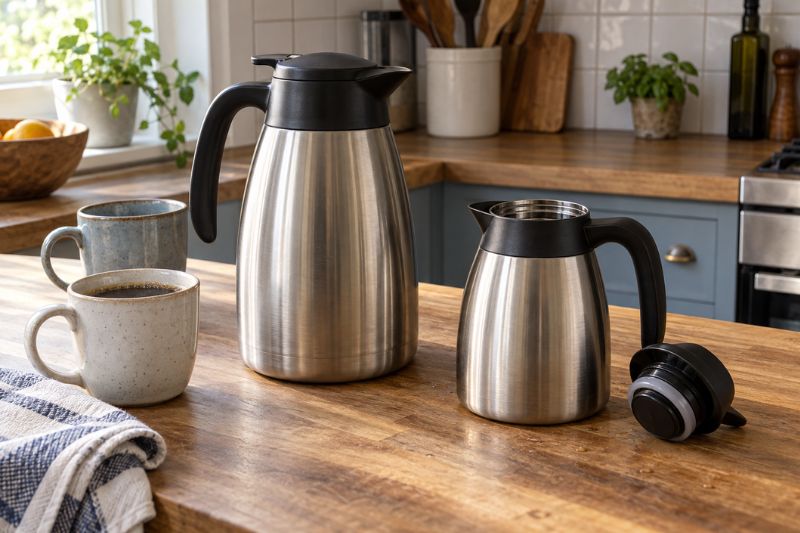
The handle should feel secure when the carafe is full, and the spout should pour cleanly without leaving coffee down the side. Removable lids and wide openings make cleaning much easier, especially around buttons and stoppers where coffee residue likes to hide.
One thing to remember: keeping coffee hot is not the same as keeping it freshly brewed. A thermal carafe slows cooling without continuously cooking the coffee on a warming plate, but the flavor will still change after several hours.
7 Best Thermal Coffee Carafes
These seven options cover everything from a small pour-over at home to a full coffee station for family gatherings or the office.
1 – Zojirushi SH-HC15 (Best balanced everyday heat retention)
| Pros | Cons |
|---|---|
| Durable stainless-steel interior | Costs more than basic carafes |
| Practical 1.5-liter capacity | Stopper takes some learning |
| Wide opening for cleaning | Not dishwasher-safe unless specified by the manufacturer |
| Removable pinch-release stopper |
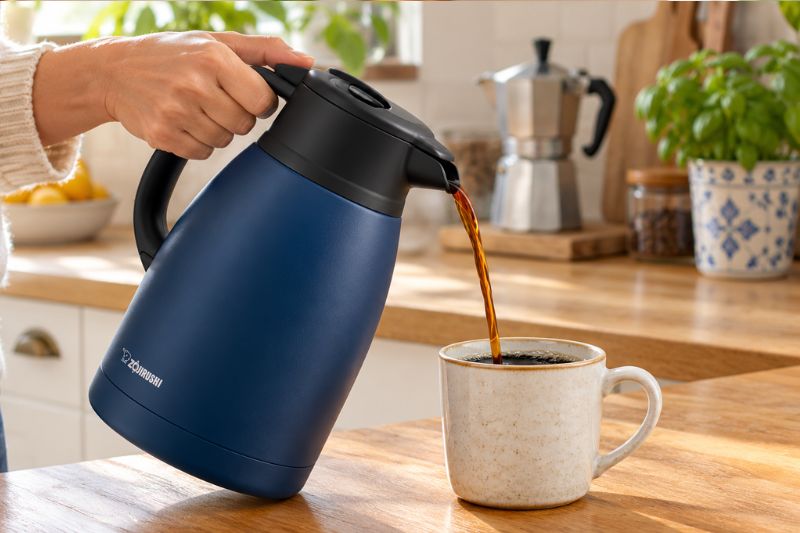
The Zojirushi SH-HC15 is the one I’d choose for most homes. Its 1.5-liter capacity holds roughly six 8-ounce mugs, which is enough for a long morning or breakfast with a few people without leaving a huge container sitting on the counter.
What makes it different is the all-stainless-steel construction. There is no glass liner hiding inside, so you don’t have to worry about breaking it when cleaning the carafe or putting it down a little too firmly. The vacuum insulation slows heat loss, while the tightly fitted stopper helps keep warmth from escaping through the top.
It also has a 2½-inch opening, which makes reaching inside with a bottle brush less annoying. The stopper can be removed and taken apart for deeper cleaning, although it may seem slightly peculiar the first time you handle it.
Heat retention can vary depending on how full the carafe is and whether you preheat it. I’d rinse it with hot water first, especially if I planned to keep the coffee around for several hours.
2 – Cresimo 68 oz Thermal Coffee Carafe (Large batches without excessive bulk)
| Pros | Cons |
|---|---|
| Large two-liter capacity | Heavy when completely filled |
| One-handed pouring | Excessive for one or two people |
| Wide opening and detachable lid | Should remain upright during transport |
| Non-slip base | |
| Works with hot or cold drinks |
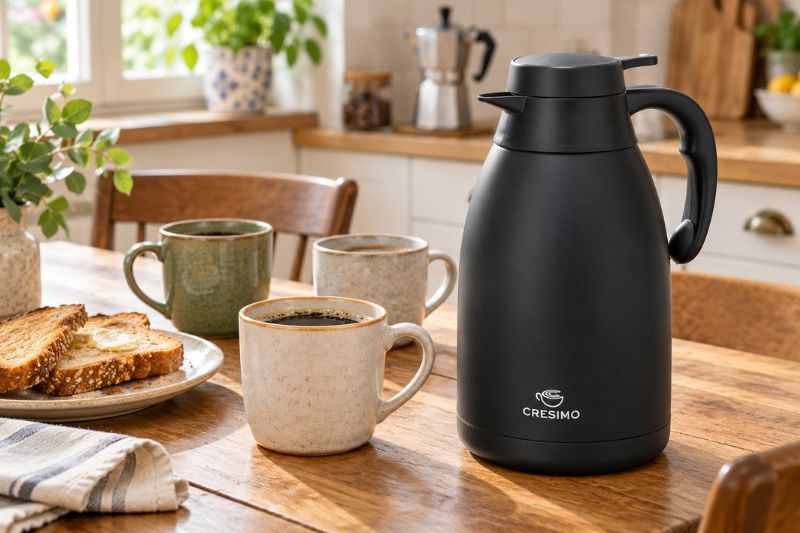
The Cresimo makes more sense when one liter of coffee disappears too quickly. Its 68-ounce capacity holds a little more than eight 8-ounce mugs. So you can transfer a full batch into it and leave the coffee machine off instead of keeping everything on a warming plate.
It is made from 18/8 stainless steel with vacuum insulation and a BPA-free plastic lid. Cresimo claims it can keep drinks hot for up to 12 hours or cold for 36 hours, although the actual result will depend on how full it is, the starting temperature, and whether you preheat it. The brand recommends filling it with hot water briefly before adding coffee.
The wide opening helps with filling and cleaning, while the locking, detachable lid allows one-handed pouring. I also like that the base is non-slip. A two-liter carafe becomes fairly heavy once filled, and I wouldn’t want it sliding across the counter while pouring.
This is probably too much carafe for one or two cups, but it works well when several people keep returning for coffee.
3 – GiNT 34 oz Thermal Coffee Carafe (Affordable size for smaller households)
| Pros | Cons |
|---|---|
| Compact one-liter capacity | Too small for large gatherings |
| More affordable than premium models | Heat-retention times are manufacturer claims |
| Wide opening for easier cleaning | May leak when heavily tilted |
| One-handed push-button pouring | |
| Stainless-steel interior and exterior |
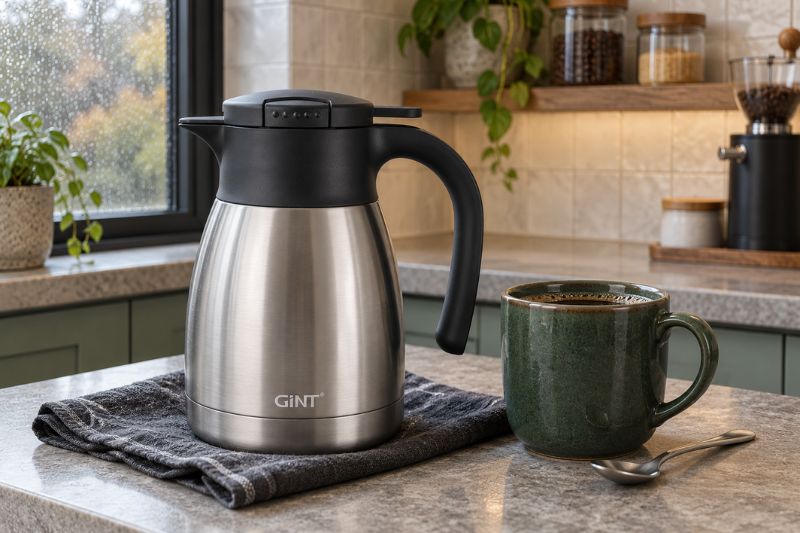
Not everyone needs a two-liter carafe sitting on the kitchen counter. The GiNT holds 34 ounces, or roughly four 8-ounce mugs, which feels more reasonable if you make a smaller pot and want to drink it slowly throughout the morning.
It uses double-wall vacuum insulation with a 304 stainless-steel interior and exterior. GiNT claims it keeps drinks hot for up to 12 hours or cold for 24, although I would treat those numbers as ideal conditions rather than a promise. How full the carafe is and whether you preheat it will make a difference.
The wide opening is useful because you can reach inside more easily when cleaning or add ice for cold drinks. Its detachable stopper and push-button mechanism also allow you to pour with one hand without unscrewing the entire lid.
Even though it says it’s leakproof, I would still keep it upright. You can still have some leaking when tilted. So this makes more sense on a breakfast table or desk than rolling around inside a car.
4 – Hario Outdoor V60 Metal Coffee Server (Unbreakable server for outdoor brewing)
| Pros | Cons |
|---|---|
| Lightweight stainless-steel construction | Not vacuum insulated |
| Won’t shatter like a glass server | Exterior becomes very hot |
| Works with V60 pour-over brewing | Small 500 mL capacity |
| Can be used over a heat source | Hand-wash only |
| Useful for camping |
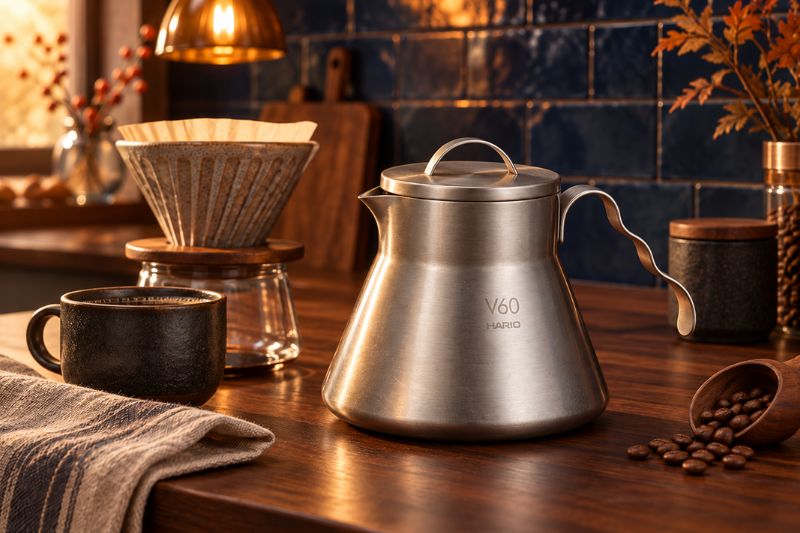
This Hario is the unusual option in the group. It is not a vacuum-insulated thermal carafe. Instead, it is a lightweight 500 mL stainless-steel server designed for pour-over coffee at home or outdoors.
Its biggest advantage is durability. A glass server can break while washing it. I’ve come close enough with slippery coffee equipment in my own kitchen, while this one is made entirely from stainless steel. It can also be placed over a heat source, including an open fire, which makes more sense for camping than a traditional glass V60 server.
The 500 mL capacity gives you roughly two regular mugs, so it suits one person or a small shared brew. It is also easy to clean, although Hario recommends washing it by hand.
One important drawback: the exterior gets very hot when filled with fresh coffee. You need to handle it carefully and possibly use a sleeve. It will not retain heat like the Zojirushi or Cresimo, but it is much harder to break.
5 – THERMOS 34-Ounce Stainless Steel Carafe (Compact shape with effortless pouring)
| Pros | Cons |
|---|---|
| Compact and stable shape | Too small for larger families or gatherings |
| Durable stainless-steel construction | Overfilling can interfere with the pour button |
| Comfortable handle | Requires space beneath the lid |
| One-handed push-button pouring | Traditional, fairly plain appearance |
| Wide opening for cleaning | Limited to about four regular mugs |
| Lifetime warranty | No glass window to check the remaining coffee |
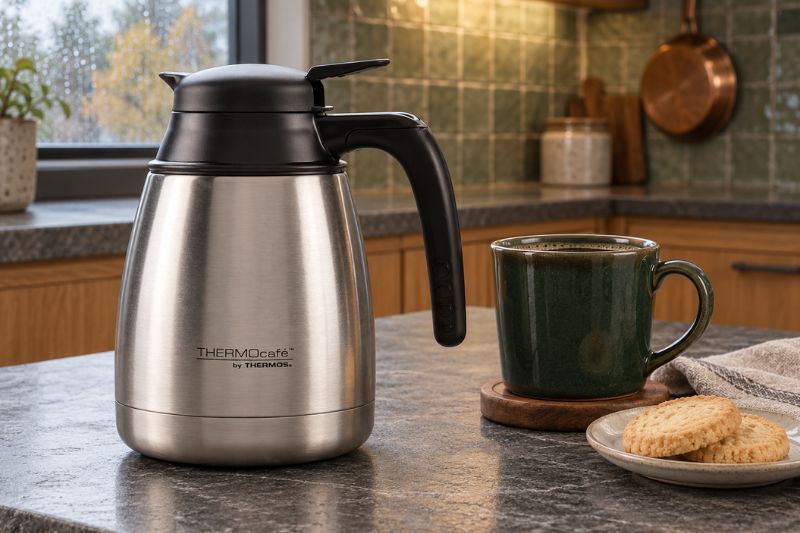
The THERMOS 34-ounce carafe has a shorter, slightly wider shape than many tall coffee carafes. That makes it easier to fit beneath some coffee machines, fill at the sink, and leave on a crowded breakfast table without worrying about knocking it over.
It uses TherMax double-wall vacuum insulation with an 18/8 stainless-steel interior and exterior. There is no glass liner inside, which removes one fragile part from something you may handle every morning. The wide mouth also makes filling and cleaning less awkward.
Its push-button lid lets you pour with one hand, while the contoured handle gives you a more secure grip. Just don’t fill it completely to the rim. Leaving some room at the top allows the lid to settle properly and keeps coffee from being pushed into the spout when you close it.
At roughly four 8-ounce mugs, this is a practical size for one or two people. It does not have the capacity of the Cresimo, but it is easier to handle when full.
6 – Stelton EM77 Vacuum Jug (Premium design with automatic pouring)
| Pros | Cons |
|---|---|
| Distinctive premium appearance | More expensive than basic carafes |
| Automatic rocker stopper | Glass liner can break |
| Smooth one-handed pouring | Requires careful cleaning |
| Separate screw-in cap | Not intended for maximum all-day heat retention |
| One-liter everyday capacity | ABS exterior may not appeal to everyone |
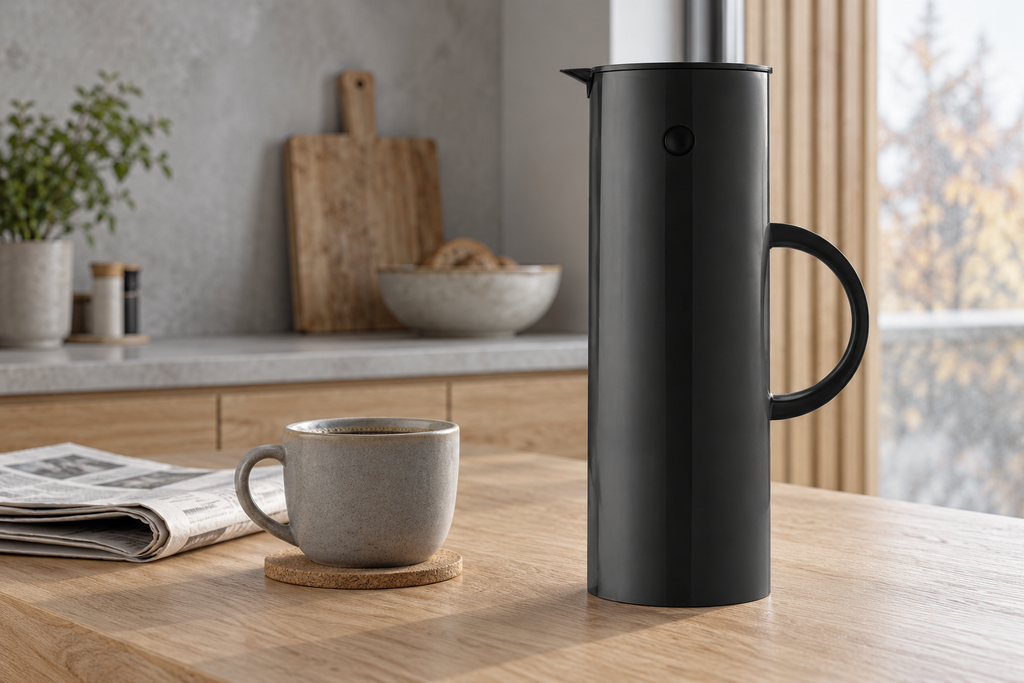
Most thermal carafes look practical and not much else. The Stelton EM77 is different. Its tall black body and clean Danish design make it feel more like part of the kitchen than something you hide in a cabinet after breakfast.
It holds one liter, or roughly four 8-ounce mugs. Unlike the stainless-steel carafes above, the EM77 uses an insulated glass liner inside an ABS plastic body. Glass can retain heat well without giving coffee a metallic taste, but it also requires a little more care. I wouldn’t knock this one against the sink while washing it.
The magnetic rocker stopper is what really separates it from the others. Pick up the jug and tilt it; the stopper opens for pouring, then closes automatically when the carafe is upright again. There is no button to hold or lid to loosen. A separate screw-in cap is included when you need a more secure closure.
It should keep coffee comfortably hot through a long morning, but its real appeal is the combination of easy pouring and design.
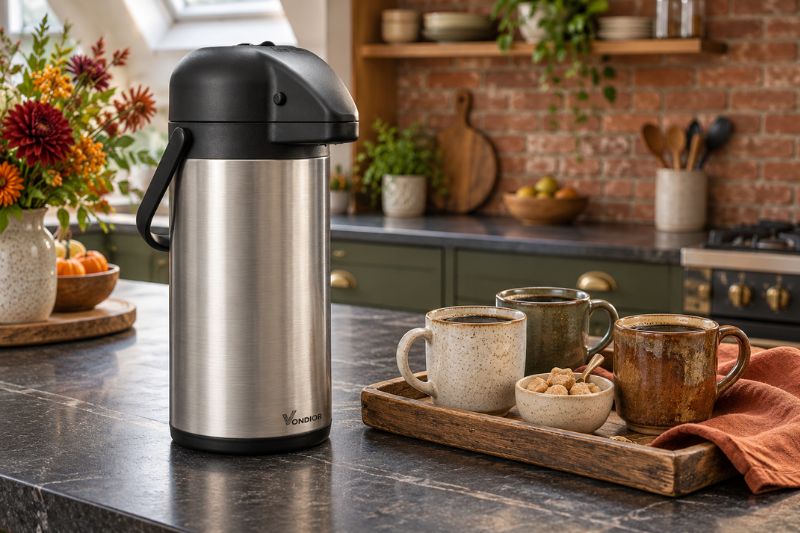
7 – Vondior 85 oz Coffee Airpot (Pump dispensing for large gathering)
| Pros | Cons |
|---|---|
| Large 2.5-liter capacity | Takes up considerable counter space |
| Convenient pump dispensing | More parts to clean |
| No heavy lifting while serving | Overkill for everyday personal use |
| Removable hinged lid | Needs preheating for the best performance |
| On/off transport lock | Coffee flavor still changes over time |
| Works for hot or cold drinks | Heavy when completely filled |
I would change the label from “Best Premium Design” because that already belongs to the Stelton. The Vondior is here because it can serve far more coffee than the other carafes.
Its 85-ounce capacity holds roughly ten full 8-ounce mugs, and the pump top means nobody has to lift and tilt a heavy container. Press the top, fill the cup, and leave it there for the next person. This works particularly well during brunch or a meeting, when coffee tends to disappear at different times.
The double-wall vacuum insulation is rated for up to 20 hours hot and 24 hours cold. Preheating matters with something this large. Fill it with hot water first, empty it, and then add the coffee so the metal interior does not immediately pull heat from the drink.
The hinged top can be removed for cleaning, while the on/off lock helps prevent accidental dispensing during transport. It is bulky and more complicated than a normal carafe, but that trade-off makes sense when several people are serving themselves.
What Size Thermal Coffee Carafe Do You Actually Need?
A larger carafe sounds better until you are cleaning a two-liter container after making only two mugs of coffee. Choose the size that matches what you normally brew, not the biggest batch you might make twice a year.
| Carafe | Best for | Capacity | Pouring mechanism |
|---|---|---|---|
| Zojirushi SH-HC15 | Best overall | 1.5 L | One-handed stopper |
| Cresimo Thermal Carafe | Families and larger batches | 2 L | One-handed pour lid |
| GiNT Thermal Carafe | Smaller households | 1 L | Push button |
| Hario Outdoor V60 Server | Outdoor pour-over | 500 mL | Open spout |
| THERMOS Stainless Steel Carafe | Easy everyday pouring | 1 L | Push button |
| Stelton EM77 | Premium design | 1 L | Automatic rocker stopper |
| Vondior Coffee Airpot | Offices and gatherings | 2.5 L | Pump dispenser |
One confusing detail is that coffee-machine “cups” are often smaller than the mug you actually drink from. Many machines use approximately 5 ounces per advertised cup. That means a 12-cup coffee maker may produce around 60 fluid ounces, not the 96 ounces you would expect from twelve 8-ounce mugs.
Try to match the carafe fairly closely to your usual batch. A mostly full carafe generally retains heat better than an oversized one with a large pocket of air sitting above the coffee
Final Thoughts
Do you normally make one or two cups, or does the coffee pot seem to empty before you sit down? Have you used a thermal carafe before, and did it actually keep your coffee hot for as long as you expected?
Let me know which carafe fits your coffee routine or which one you already use in the comments below. And voilà.
FAQ
1 – How long does a thermal coffee carafe keep coffee hot?
A good thermal carafe should keep coffee comfortably hot for several hours. Some are rated for 10, 12, or even 20 hours, but those longer times usually depend on the carafe being preheated, nearly full, and kept closed. The coffee may still be warm later, though that does not mean it will taste as fresh as it did after brewing.
2 – Is stainless steel or glass-lined insulation better?
Stainless steel is the better choice if durability matters because it can survive the occasional knock against the sink.
Glass-lined carafes can retain heat well and will not add a metallic note, but the liner may break if dropped or handled roughly. I would choose stainless steel for daily use and glass mainly when appearance and tabletop serving matter more.
3 – Should I preheat a thermal coffee carafe?
Yes, particularly if you want the best possible heat retention. Fill the carafe with hot water, leave it for about a minute, empty it, and then add your coffee.
Otherwise, the room-temperature interior immediately absorbs some of the heat. It is a small step, but it can make a noticeable difference.
4 – Can a thermal coffee carafe go in the dishwasher?
That depends on the specific carafe, so check its cleaning instructions first. Many thermal carafes should be washed by hand because dishwasher heat and water can damage the seals, finish, or vacuum construction.
A wide opening and removable lid make hand-washing much easier. Pay particular attention to the stopper and spout, where old coffee oils tend to hide.