

Conical vs. Flat Burr Grinders: Which Is Best for 2026?
Last updated on May 21st, 2026 at 03:11 pm
When I first started brewing coffee at home, I used a cheap blade grinder and honestly thought that was just… how coffee was. Sometimes it tasted fine. Other mornings it was bitter, hollow, or oddly sharp, and I couldn’t figure out why. Same beans and method. Different results every time.
It took me longer than I’d like to admit to realize the grinder was the problem.
Once I started looking for an upgrade, I ran straight into the question everyone eventually hits: conical vs. flat burr grinders. And suddenly, buying a grinder felt way more complicated than it needed to be.
One side said conical burrs were easier, more forgiving, better for most people. The other swore flat burrs were the only way to get “real” coffee, especially espresso.
I remember going down review rabbit holes, watching comparison videos, and still feeling unsure. I didn’t want to become a coffee scientist. I only wanted my coffee to taste good consistently.
So instead of chasing opinions, I started paying attention to what changed my coffee in the cup.
That’s what this guide is about.
A clear breakdown of how conical and flat burr grinders differ, what each one does well, and which makes more sense depending on how you brew. By the end, you’ll know which one fits your coffee routine, without second-guessing the choice.
Conical vs. Flat Burr Grinders: Head-to-Head Comparison
Choosing between a conical and a flat burr grinder isn’t really about which one is “better.” It’s about what matters to you when you’re making coffee day after day.
Before getting lost in specs, it helps to pause and ask a few simple questions. Do you care more about consistency or convenience? Is noise going to drive you crazy in the morning? Are you brewing espresso daily, or mostly drip and pour-over?
I didn’t have clear answers at first either. I just knew something felt off with my coffee. So I started testing: switching grinders, dialing in shots, grinding for different brew methods, making way more cups than necessary to see what changed in the cup.
What I learned is that conical and flat burr grinders behave differently in ways that don’t always show up on a spec sheet, but you notice them when you use them.
Here’s a straightforward breakdown of the real differences between conical and flat burr grinders, based on how they perform, sound, feel, and ultimately affect your coffee.
| Criteria | Conical Burr Grinders | Flat Burr Grinders |
|---|---|---|
| Grind Consistency | Produces a slightly bimodal grind (mix of fines + larger particles). Forgiving and well-suited for most brew methods. | Produces a more uniform grind size, which benefits espresso and precision-focused brewing. |
| Flavor Profile | Often highlights body and sweetness, with a rounder, more forgiving extraction. | Tends to emphasize clarity, separation of flavors, and acidity when dialed in correctly. |
| Grind Size Range | Very versatile: works well for drip, pour-over, French press, AeroPress, and casual espresso. | Excels at espresso and precise filter brewing; capable across many methods but less forgiving. |
| Heat Generation | Generally runs cooler due to slower feed and lower RPMs, helping preserve aroma. | Can generate more heat at higher speeds, though this is less of an issue in modern designs. |
| Noise Level | Usually quieter and lower-pitched, especially in home grinders. | Often louder and sharper-sounding, particularly in commercial-style models. |
| Ease of Maintenance | Simpler internal design; easier cleaning and fewer alignment concerns. | More complex alignment and cleaning; burr alignment matters more for performance. |
| Price & Availability | Widely available at all price points, including budget and mid-range grinders. | More common in mid-range to high-end grinders; typically more expensive overall. |
| Best For | Home brewers who want versatility, ease of use, and consistency without fuss. | Espresso-focused users and enthusiasts who enjoy dialing in and chasing precision. |
Note: Conical burr grinders are easier to live with and more forgiving, making them a solid all-around choice for most brew methods. Flat burr grinders shine when precision matters, especially for espresso. But they usually cost more and require more dialing in.
If you want one grinder for everyday coffee, a conical is the safer bet. If espresso is your main focus, flat burrs are worth a closer look.
What Are Burr Grinders and Why Do They Matter?
If you’ve spent any time around coffee people, you’ve probably heard the phrase “you need a burr grinder” thrown around like it’s obvious. I didn’t think it was obvious at all, at least not until I tasted the difference.
Blade grinders don’t really grind. They chop. You end up with a mix of dust and chunks. This means some coffee over-extracts while other bits barely extract at all. That’s how you get a cup that tastes confused.
Burr grinders work differently. Instead of chopping, they crush beans between two burrs, producing a much more consistent grind. When the particles are closer in size, water flows evenly through them. Suddenly, your coffee tastes balanced instead of unpredictable.
Think pebbles versus gravel. Same material, totally different results. That’s why burr grinders aren’t all created equal. You’ll mostly run into two types: conical and flat burr grinders.
How Conical Burr Grinders Work?
Conical burr grinders use a vertically aligned burr set shaped like a cone (hence the name). Coffee beans drop from the top and are ground as they move downward, mostly under gravity’s pull. Think of it like a controlled funnel rather than a force-fed system.
That gravity-assisted design is a big reason conical burr grinders are so common. They’re efficient, need less motor power, and generally produce less heat while grinding.
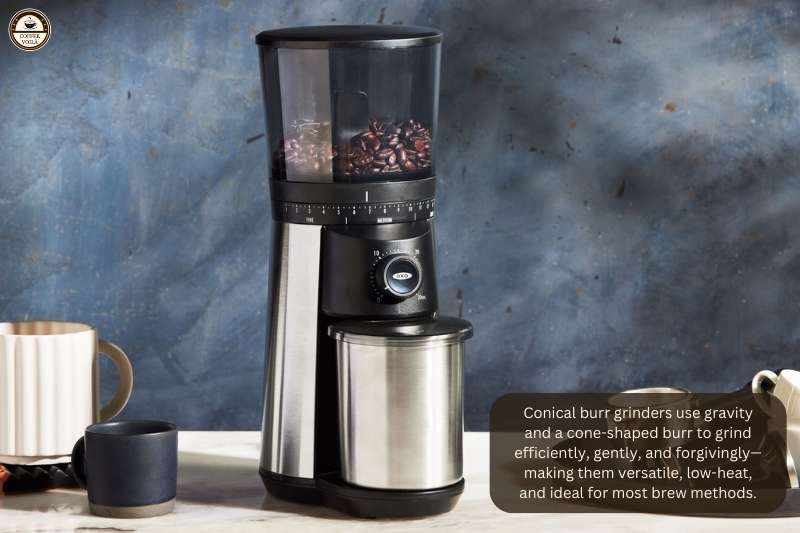
That’s why you’ll see them everywhere, from manual hand grinders to entry-level and mid-range electric models. Less heat also matters more than people realize, since overheating beans can dull aromas before they ever hit your cup.
Different sizes
You’ll also notice conical burrs come in a wide range of sizes, from small hand-grinder burrs to large commercial sets like 83mm conical burrs. Bigger burrs don’t automatically mean “better.” But they do grind faster, more consistently, and with even less heat buildup. That’s why cafés and high-end grinders prefer them.

Bimodal particles
Now for the part that confuses people at first: bimodal particle distribution.
Conical burrs naturally produce a mix of slightly larger grounds and finer particles in the same grind. That might sound like a flaw, but it’s one of their strengths. Those finer particles help boost body and sweetness. Meanwhile, the larger ones slow the extraction and prevent bitterness.
For brewing methods like pour-over, drip, AeroPress, and even French press, this balance can create a cup that feels fuller and more forgiving. You don’t need perfect technique to get good results, which is exactly why conical burr grinders are often recommended for beginners and why many experienced brewers still stick with them.
In short, conical burr grinders prioritize efficiency, flexibility, and consistency without fuss. They’re not trying to hit laboratory-level uniformity. They’re designed to make good coffee, day after day.
How Flat Burr Grinders Work?
Flat burr grinders use two horizontally aligned burrs. Basically flat discs with sharp cutting teeth. Beans drop between them and get crushed outward as the burrs spin, kind of like pressing coffee between two precision-machined plates.
The key here is control. Everything happens on the same plane, at the same distance, which is why flat burrs are known for producing a very uniform grind.

That uniformity is the big selling point. Flat burr grinders tend to create a narrower particle size distribution, meaning fewer stray fines and fewer oversized chunks.
For espresso especially, that matters a lot. When particles are closer in size, water flows more evenly through the puck, and you get shots that taste clearer, sweeter, and more repeatable. Dialing in becomes less of a guessing game.
I still remember the first time I pulled espresso with a flat burr grinder after years of inconsistent results. Same beans, same machine. But suddenly the shot tasted cleaner and more focused. Less muddled and sharper.

What are the trade-offs?
Flat burrs usually spin faster and rely more on motor power. This can lead to higher heat buildup if the grinder isn’t well-designed.
Cheaper flat burr grinders are especially guilty of this, and excess heat can mute aromas or push flavors toward bitterness. They also tend to be louder. That sharper, higher-pitched grind that cuts through a quiet kitchen at dawn.
When should you get one?
Flat burr grinders shine when precision is the priority. Espresso, light roasts, repeatability. They reward careful dialing-in and consistent technique. If that sounds like your kind of coffee routine, they’re hard to beat. But don’t expect them to be the quietest or most forgiving option on the counter.
Popular Conical Burr Grinders to Consider in 2026
Here are a few conical burr grinders that still make sense in 2026. Not because they’re trendy, but because they consistently deliver good coffee without unnecessary complexity.
Baratza Encore
The Baratza Encore has earned its reputation the slow, boring way by working, day after day. It’s often the first “real” burr grinder people buy after realizing their blade grinder is sabotaging every brew.
With around 40 grind settings, it comfortably covers drip, pour-over, AeroPress, and French press without making things complicated.

What really keeps the Encore relevant is how forgiving it is. You don’t need to obsess over tiny adjustments to get good coffee, and maintenance is simple if something ever goes wrong. It’s not an espresso specialist. But for everyday brewing, it still hits a sweet spot between price, reliability, and consistency.
Breville Smart Grinder Pro
If you’re the kind of person who likes tweaking and dialing things in, the Smart Grinder Pro makes sense. You get a wide grind range. Fine enough for espresso, coarse enough for cold brew. Plus a digital interface that helps instead of getting in the way.

It feels more “appliance-like” than the Encore, with timed dosing, memory settings, and a cleaner workflow overall. It’s louder and more complex. But if you bounce between brew methods and want repeatable results without guesswork, it earns its place on the counter.
1Zpresso JX-Pro
The JX-Pro shows that manual doesn’t mean compromise. It has a solid build and grind quality that exceeds expectations. The adjustment is precise, the burrs are quick, and once you find your rhythm, grinding feels easy.

This one works especially well for travel, small kitchens, or anyone who values control and consistency over convenience. All you need are your beans, the burrs, and a bit of effort. If espresso is part of your routine and you don’t mind using your arms, it’s still one of the strongest manual options available.
Popular Flat Burr Grinders to Consider Going Forward
These are a few standouts that still make sense if precision is your priority.
Eureka Mignon Specialità
If espresso is your main focus, this one keeps coming up for a reason. The grind consistency is excellent. The stepless adjustment makes fine-tuning shots painless, and it’s noticeably quieter than most grinders in its class.

It feels purpose-built for home espresso drinkers who want café-level control without a massive commercial machine on the counter.
Fellow Ode Brew Grinder
The Ode goes in a different direction and does it well. It’s designed specifically for brewed coffee: pour-over, drip, French press. The flat burrs produce clean, uniform grounds, which translates to clarity in the cup. Just be aware: it’s not meant for espresso, and trying to force it into that role will only frustrate you.

Mazzer Mini
This one’s a classic. Built like a tank, originally designed for cafés, and capable of grinding all day without flinching. It’s bigger, heavier, and more expensive than most home grinders. But if longevity and grind consistency matter more than counter space, the Mazzer Mini earns its reputation.
Each of these grinders leans heavily toward precision. They’re less about convenience and more about control. If that sounds like your style, flat burrs are where things start to get very interesting.
Top Flat Burr Grinders to Consider in 2025
Eureka Mignon Specialita
If you’re serious about espresso, the Specialita is a top contender. It’s known for its super consistent grind and silent operation—so you won’t wake the whole house when pulling that early-morning shot!
Plus, it has a stepless adjustment, which gives you precise control over the grind size, making it perfect for dialing in the perfect espresso.
Fellow Ode Brew Grinder
This one is a beauty! It’s compact, has a sleek modern design, and is built specifically for drip coffee, pour-over, and French press. The Ode’s flat burrs produce uniform particles, ensuring every cup is clear and flavorful.
But here’s the thing: it’s not ideal for espresso, so if you’re a strictly espresso drinker, you might want to skip this one.
Mazzer Mini
A true powerhouse designed for commercial use, but hey, if you’re a serious home brewer, it’s worth considering. This grinder is known for its durability and can handle heavy daily use without breaking a sweat.

It’s on the pricier side and might take up a bit more counter space, but for anyone obsessed with precision and longevity, the Mazzer Mini is the real deal.
Last Thoughts: Which One Should You Pick?
If you want one grinder that does almost everything without overthinking it, conical burrs are usually the smarter choice. They’re more affordable, easier to live with, quieter, and flexible enough for French press, pour-over, AeroPress, and even the occasional espresso without constant frustration.
On the other hand, flat burrs are about control. They shine when precision matters, especially for espresso and reward people who enjoy dialing things in, adjusting by tiny increments, and chasing clarity in the cup. They cost more, take up more space, and ask more from you… but for the right person, that’s the appeal.
If you’re newer to home brewing, conical burrs tend to be more forgiving. If you’ve already gone down the rabbit hole and know exactly what you want from your coffee, flat burrs start to make a lot of sense.
Still on the fence? That’s normal. Coffee gear choices rarely look obvious at first. Drop a comment, share what you brew most, or what’s been frustrating about your setup. Those details matter more than specs ever will.
Questions? We Have Answers.
Get answers to a list of the most Frequently Asked Questions.


Have had several burr grinders, and not one didn’t produce fine dust along with med grind, you might want to do a real study and use screens to check what the grind size really is coming out of your misconstrued ideal burr grinder.