Espresso Ratio Chart (Printable Brew Guide)
When you first start using an espresso machine, things don’t exactly fall into place. I remember those early shots on my Barista Express. They looked fine, sometimes even decent… and then you taste it. Off. Sour one day, bitter the next, and you’re standing there wondering what just changed.
Most people start tweaking everything. Grind size, dose, tamp, maybe even the beans. I did the same. You keep adjusting, hoping something clicks, but it turns into a loop where nothing feels consistent and every shot feels like starting over.
And the strange part is, the thing that usually brings it all together isn’t complicated at all. It’s something simple that gets overlooked early on.
The relationship between how much coffee you use and how much ends up in the cup. Once that clicks, things start to settle. Not perfect, but at least predictable. That’s where an espresso ratio chart comes in.
What Is an Espresso Ratio?
An espresso ratio is the relationship between how much coffee you start with and how much liquid ends up in the cup.
Simple, on paper.
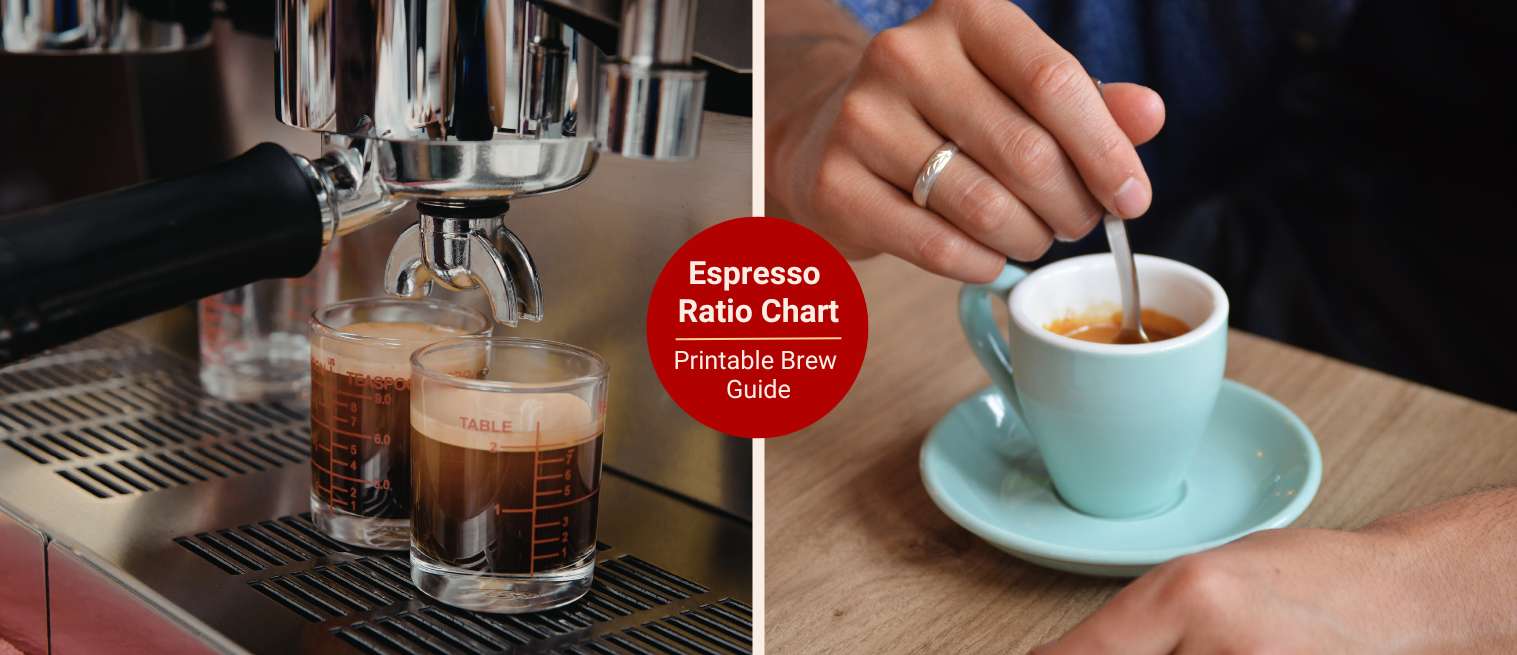
You weigh your dose, say 18 grams of ground coffee, and then measure how much espresso comes out. If you stop the shot at 36 grams, that’s a 1:2 ratio. One part coffee and two parts liquid.
That’s it. And also not quite.
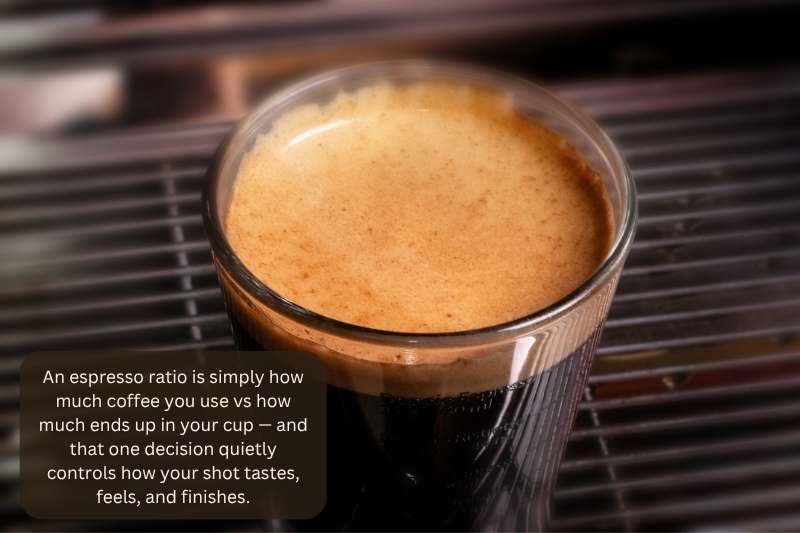
Because that small relationship ends up shaping almost everything in the cup. For instance, strength, texture, and how heavy or light it feels. Even the way flavors show up. Sometimes sharp, sometimes balanced, sometimes just missing something.
It’s written as a ratio to keep things consistent because volume can mislead a bit. Crema expands, cups vary but weight stays steady. So instead of guessing, you’re working with something repeatable.
18g in → 36g out → 1:2
Now, if you stop the shot earlier, say at 27g instead of 36g, you get a shorter ratio (around 1:1.5). The espresso tends to feel thicker, more concentrated. Push it further, maybe 45g or more, and it stretches out. Lighter, sometimes flatter, occasionally bitter if it goes too far.
So the ratio isn’t a number you follow. It’s closer to a stopping point you decide ahead of time how much espresso you want from that dose before you cut the shot.
Want better espresso at home? At reliable machine makes all the difference.
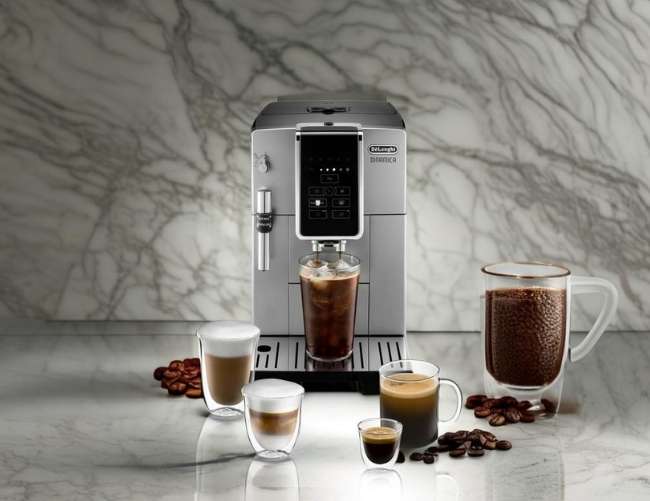
12 Best Home Espresso Machines (2026)
From beginner models to prosumer setups, we highlight:
Best overall, budget, automatic, and café-quality picks
Why Espresso Ratios Matter?
This is the part that quietly changes everything, even if it doesn’t look like much at first.

Affects taste (balanced, sour, or bitter)
A small shift in ratio can push a shot in completely different directions. Too short and it can taste sharp or underdeveloped. Too long and it drifts into bitterness. Somewhere in between… it settles.
Helps you dial in consistently
Without a ratio, you’re mostly guessing. One shot might work, the next won’t, and you’re not sure why. Keeping the output fixed gives you something to return to, even when everything else feels off.
Works together with grind size and time
These things don’t operate separately. A finer grind slows things down, a coarser one speeds it up. But the ratio decides where you stop the shot. Change one, and the others start reacting.
More reliable than guessing by volume
Crema can make a shot look bigger than it really is. Cups vary. Even your eyes can trick you early on. A scale doesn’t. It just tells you what came out.
It ends up being the reference point you keep coming back to. Not perfect, not fixed forever. But something steady enough to build around.
Standard Espresso Ratios Explained
You’re really only working within a small range. But where you stop inside that range changes the shot more than you’d expect.
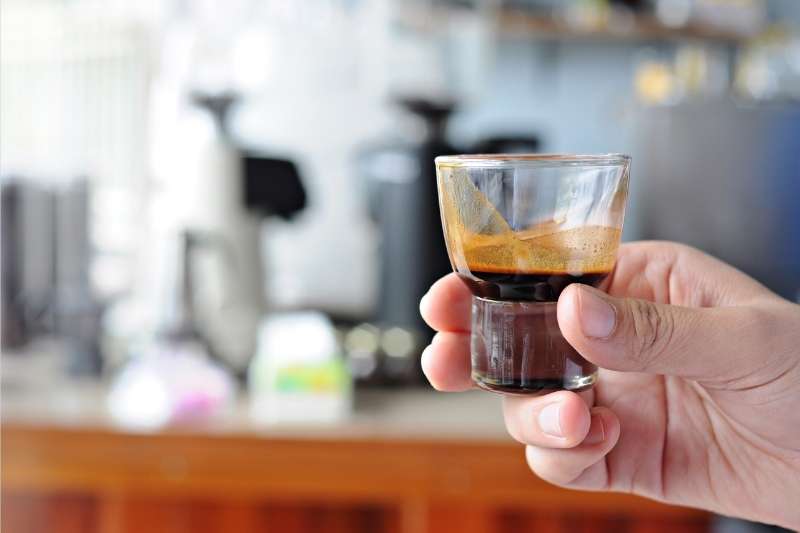
Ristretto (1:1 – 1:1.5)
- Shorter shot
- More concentrated
- Sweeter, heavier body
This is where the shot is cut early. Less liquid passes through the coffee, so what you get feels tighter, thicker. Sometimes sweeter and a bit intense. It’s not stronger exactly, but more compact.
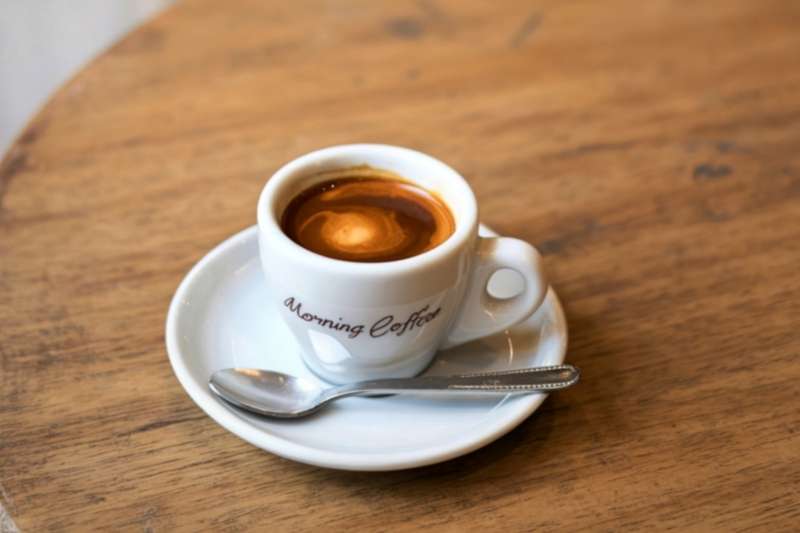
Espresso (1:2)
- Classic ratio
- Balanced flavor
- Most common starting point
This is the reference point most people come back to. Enough extraction to bring things into balance without stretching them out too much.
If something tastes off, this is usually where you return before changing anything else. It’s not perfect, but it’s stable.
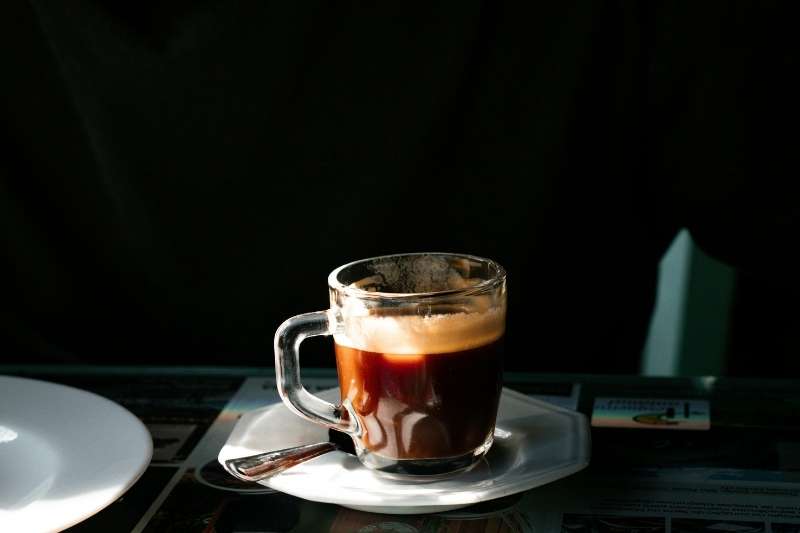
Lungo (1:3 – 1:4)
- Longer extraction
- More diluted
- Can become bitter if overdone
Here, the shot keeps going. More water passes through, pulling out more from the coffee.
At first it feels lighter. Then, if you keep pushing it, the bitterness starts to show up. Not always immediately. Sometimes halfway through the cup, which is worse.
Espresso Ratio Chart (Quick Reference + Printable)
This is the part you end up glancing at mid-shot, not reading start to finish.
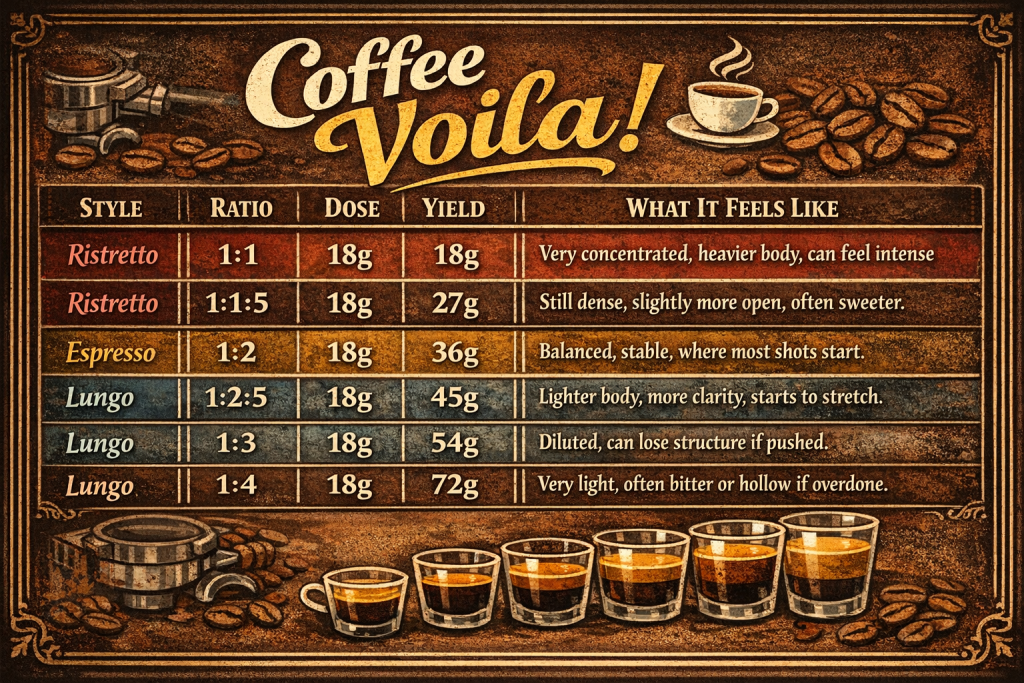
A couple small corrections compared to most charts floating around:
- 1:2.5 is worth including: it sits right in that awkward middle people end up dialing into without realizing
- 1:4 isn’t really a goal: it’s more of a boundary where things usually fall apart
- Keeping the dose fixed (like 18g) makes it easier to see what’s actually changing
If you print this, don’t treat it like rules. More like a set of guardrails you lean on when a shot starts drifting somewhere you didn’t expect.
How to Use This Ratio Chart
You don’t really “study” this. Instead, you use it mid-process, usually while something’s already going slightly off.
Step 1: Choose a ratio (start with 1:2)
Most of the time, this is where you begin. Not because it’s perfect, but because it’s stable enough to show you what’s happening.
Step 2: Weigh your dose
Pick a number and stick with it for now (18g is common). Changing this later is fine, but not yet. One variable at a time or it gets confusing fast.
Step 3: Stop the shot at the correct yield
Watch the scale, not the cup. When it hits your target (36g for a 1:2), stop it there. Even if it looks a little off. Especially then.
Step 4: Adjust grind if needed
If the shot runs too fast or drags too long, the grind is usually where you go next. Finer slows it down. Coarser speeds it up. Small changes matter more than they should.
It stays simple until you start changing everything at once. That’s usually where things fall apart.
Ratio vs Shot Time (Quick Explanation)
These two get mixed up all the time. They’re related, but they’re not the same thing, even if it feels like they should be.
- Ratio = how much you extract: It’s the endpoint. How far you let the shot run before stopping.
- Time = how fast it gets there: Same destination, different speed. And that speed changes how the coffee behaves on the way. You can hit the exact same ratio and still get two completely different shots.
- 1:2 in 15 seconds → under-extracted: It runs too fast. The water passes through without really pulling much out. Often tastes thin and sometimes sharp.
- 1:2 in 40 seconds → over-extracted: Slower, but not better. It keeps pulling past the good parts into bitterness.
So the ratio tells you where to stop. Time tells you how things went while getting there. They work together.
Best Ratios for Different Drinks
The grind, the dose, the machine, those stay the same. What changes is just where you stop the shot.
Straight espresso → 1:2
This is where things tend to settle. Not too tight, not stretched out. If something tastes off, this is usually where you come back to before changing anything else.
Milk drinks → 1:2 or slightly shorter
Milk softens everything. A slightly shorter shot, maybe closer to 1:1.5, helps the coffee hold its ground a bit better once it’s mixed in. Otherwise it can disappear faster than you think.
Strong flavor → 1:1.5
Less yield, more weight. The shot feels denser, sometimes sweeter, sometimes just… more present. It can lean intense if you push it too far, though.
Lighter profile → 1:2.5–1:3
Letting the shot run longer opens it up. More clarity, less body. Sometimes it works nicely, especially with lighter roasts. Other times it just thins out and loses structure halfway through the cup.
Last Thoughts
Still unsure where your shots should land? Are you stopping too early or letting it run because it looks right?
Does your espresso taste sharp one day and flat the next, even though you didn’t change much? Or maybe you’re hitting the numbers 1:2, right on and it still doesn’t taste the way you expected.
That’s usually where the real questions start showing up. If you’re stuck dialing in, or something just isn’t clicking yet, drop it in the comments below. I’ll take a look.
Questions? We Have Answers.
Get answers to a list of the most Frequently Asked Questions.