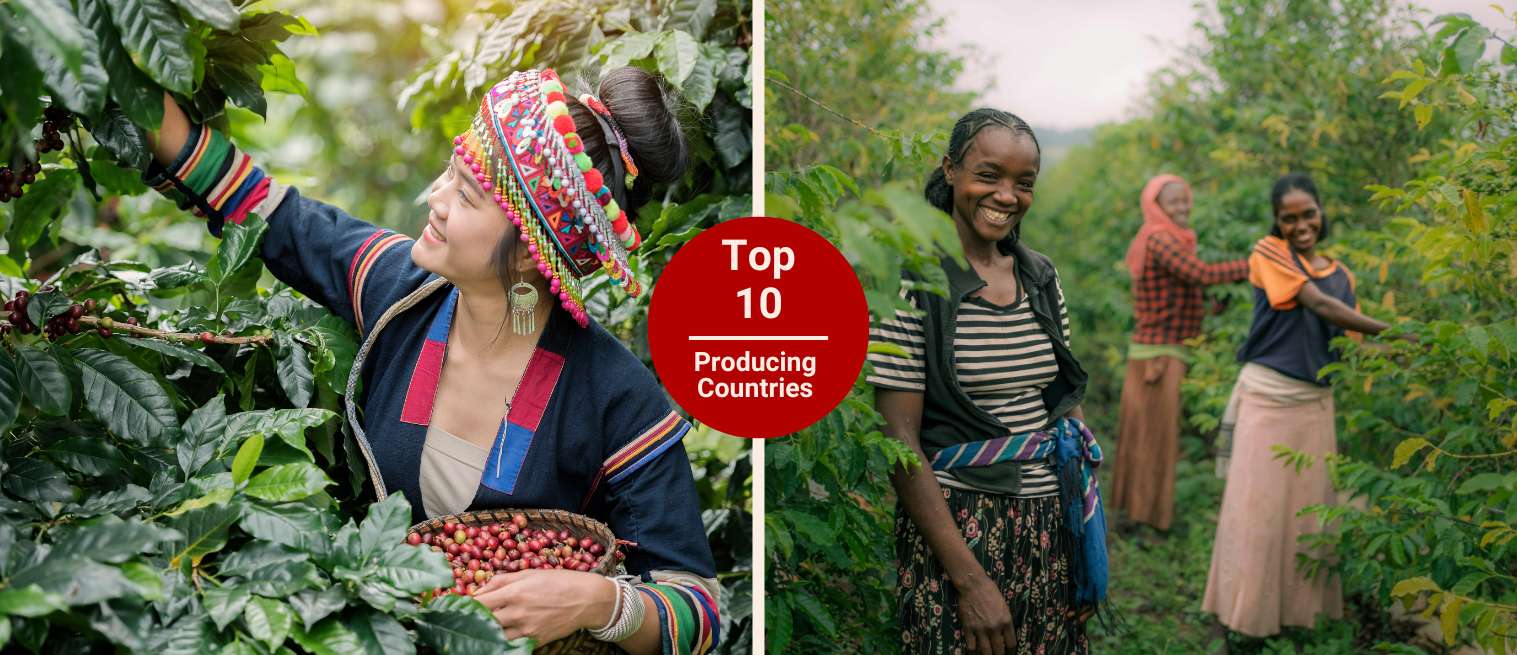
Top 10 Coffee Producing Countries Worldwide in 2026
Have you ever noticed how one cup of coffee tastes like smooth chocolate, and the next one hits you with bright citrus and flowers… even when you brewed them the exact same way?
That’s not in your head. It’s geography.
Catchy fact: Coffee is grown in around 80 countries. But just a handful of them produce most of the world’s supply, which means the “big origins” you see on bags are basically shaping what the entire planet drinks every day.
Some places (like Vietnam) are famous for bold, punchy Robusta that powers espresso blends and instant coffee. Others (such as Ethiopia) are known for floral, tea-like Arabica that tastes almost unreal when it’s brewed fresh.
And once you start paying attention to where your beans come from… you can’t untaste it.
In this guide, you’ll discover the top coffee-producing countries worldwide, what makes each origin special, the flavor profiles you can actually expect, and a few well-known brands you might recognize. So let’s start travelling!
Top 10 Coffee Producing Coffee Worldwide
This table gives you a quick snapshot of the 10 regions, keep reading for the details behind each one.
| Country | Main Coffee Type | Flavor Profile | Key Regions | Key Features |
|---|---|---|---|---|
| Brazil | Arabica, Robusta | Nutty, chocolatey, smooth | Minas Gerais, São Paulo, Espírito Santo | Largest coffee producer worldwide |
| Vietnam | Robusta (mostly) | Bold, earthy, strong body | Central Highlands | World’s #1 Robusta producer |
| Colombia | Arabica | Balanced, sweet, fruity | Antioquia, Huila, Coffee Triangle | Famous for mild, high-quality Arabica |
| Indonesia | Robusta, Arabica | Earthy, spicy, herbal | Sumatra, Java, Sulawesi | Known for unique processing styles |
| Ethiopia | Arabica | Floral, citrusy, tea-like | Sidamo, Yirgacheffe, Harrar | Birthplace of Coffea arabica |
| Honduras | Arabica | Sweet, fruity, chocolatey | Copán, Montecillos, Opalaca | Biggest producer in Central America |
| Peru | Arabica | Clean, bright, lightly fruity | Chanchamayo, Amazonas, San Martín | Rising specialty + organic reputation |
| India | Arabica, Robusta | Spicy, earthy, full-bodied | Karnataka, Kerala, Tamil Nadu | Famous for Monsooned Malabar |
| Uganda | Robusta (mostly), Arabica | Bold, earthy, cocoa-like | Lake Victoria Crescent, Mt Elgon | One of Africa’s top Robusta origins |
| Mexico | Arabica | Nutty, chocolatey, mild spice | Chiapas, Veracruz, Oaxaca | Strong focus on organic/shade-grown |
1 – Brazil (Massive output, endlessly versatile flavors)

| Region | Main Coffee Type | Flavor Profile | Production Share | Key Features |
|---|---|---|---|---|
| Minas Gerais | Arabica | Smooth, nutty, chocolatey | Largest share in Brazil (often ~40–50%) | Brazil’s #1 coffee-producing state |
| São Paulo (Mogiana) | Arabica | Sweet, fruity, balanced | Strong producer (especially Mogiana) | Bright, lively flavors + quality lots |
| Espírito Santo | Robusta (Conilon) | Bold, earthy, heavy-bodied | Brazil’s main Robusta/Conilon hub | Great for blends, crema, and instant coffee |
Brazil is still the giant of the coffee world, producing around a third of the planet’s coffee (and in some seasons, even more). It’s basically the backbone of the global supply chain. If Brazil has a “bad harvest year,” everyone feels it.
What makes Brazil so dominant is how many different coffee landscapes it has. Regions like Minas Gerais, São Paulo, and Espírito Santo have that sweet spot combo of stable weather, big farms, and the kind of soil that works. This means Brazil can produce everything from easygoing daily coffee to complex specialty lots.
Minas Gerais is the heart of it all. It’s Brazil’s main coffee-producing state, and it’s especially known for smooth, chocolatey, nutty Arabica. The type of coffee that tastes “clean” and comforting without trying too hard.
São Paulo (especially the Mogiana area) tends to lean a little brighter and sweeter, with more caramel + fruit notes. It’s still very “Brazil,” but with a bit more personality in the cup.
Then you’ve got Espírito Santo, which is famous for Robusta (Conilon). Stronger, heavier-bodied coffee that’s often used in espresso blends and instant coffee, and it’s a big reason Brazil can serve both the specialty crowd and the mass market.
When you go shopping, you’ll see big-name Brazilian brands. For instance, Café Pilão (bold and classic), 3 Corações (tons of blends and styles), and Café do Ponto (more premium-leaning options). Brazil isn’t just “a coffee origin”… it’s a whole coffee universe.
2 – Vietnam (World’s top Robusta powerhouse)

| Region | Main Coffee Type | Flavor Profile | Production Share | Key Features |
|---|---|---|---|---|
| Central Highlands (Đắk Lắk, Gia Lai, Kon Tum) | Robusta | Bold, earthy, strong body, chocolatey/nutty | ~75–85% of Vietnam’s total coffee | Main growing belt + biggest volume region |
| Lam Dong (Da Lat area) | Arabica | Milder, fruitier, sometimes floral | Smaller share (Arabica-focused) | Higher elevation + cooler climate |
| Son La (Northwest Vietnam) | Arabica | Bright, clean, balanced | Emerging specialty region | Growing reputation for quality Arabica |
Vietnam is a Robusta powerhouse. It’s one of the world’s biggest Robusta producers, with output forecast at about 30 million 60-kg bags in 2025/26, accounting for roughly 40% of global Robusta production.
And the Central Highlands, especially Đắk Lắk, Gia Lai, and Kon Tum, are the heart of that production, responsible for the bulk of Vietnam’s coffee output.
Robusta from this region isn’t just heavy on caffeine. It’s rich, bold, and a foundation for many of the instant coffee blends you see on shelves worldwide. If you’ve ever had classic instant coffee with a thick texture or a strong body, there’s a good chance it includes Robusta from Vietnam.
But Vietnam isn’t only Robusta. There are pockets where Arabica shines, too. The cooler climate of Lâm Đồng (in the southern Central Highlands) produces Arabica beans with milder, fruitier, and more floral notes than the country’s Robusta-heavy profile.
And more recently, regions like Sơn La in the northwest have been drawing attention for bright, balanced Arabica that’s beginning to turn heads in specialty circles.
So, while Vietnam’s strength is undeniably in volume and Robusta production, there’s real diversity emerging. From bold, utilitarian beans to more nuanced Arabicas that appeal to different palates.
If you’re exploring Vietnamese coffee yourself, there are some well-known brands worth trying:
- Trung Nguyên — famous for rich blends that mix Arabica and Robusta, and central to traditional Vietnamese coffee culture.
- Vinacafé — a hugely popular name in instant coffee blends and classic Vietnamese flavors.
- Highlands Coffee — known for premium beans and coffeehouse-style brews across Vietnam and beyond.
Vietnam’s coffee scene may be best known for strength and volume. But its evolving regional flavors show there’s more to discover than simply bold Robusta.
3 – Colombia (Clean, balanced high-altitude Arabica)

| Region / Area | Main Coffee Type | Flavor Profile | Production Share / Role | Key Features |
|---|---|---|---|---|
| Huila | Arabica | Bright acidity, fruity & floral | Top producing department (often ~18%+) | Highly regarded specialty coffee; varied microclimates |
| Antioquia | Arabica | Medium body, chocolate & nut notes | Major producer (~15–16%+) | Classic and historic coffee heartland with balanced profiles |
| Coffee Triangle (Caldas, Quindío, Risaralda) | Arabica | Balanced, sweet, floral & fruity | Central coffee region | UNESCO Coffee Cultural Landscape; broad range of quality lots |
When people say “Colombian coffee,” they usually mean something smooth, clean, and well-balanced. Just that sweet spot where the cup tastes comforting, but still has enough brightness and sweetness to keep it interesting.
What makes Colombia special is how much variety you get depending on where the beans are grown. The country has mountains everywhere, tons of microclimates, and coffee farms spread across different elevations. So the flavor changes a lot from region to region.
Antioquia is one of the classic heavy-hitters. Coffees from here tend to be super reliable with a balanced body, gentle acidity, and notes like chocolate, nuts, and caramel. It’s the kind of coffee that works for almost anyone, especially if you prefer a “daily driver” brew that doesn’t surprise you too much.
On the other hand, Huila is where things get a little more “specialty.” This region is known for coffees that can taste fruitier and more floral, with brighter acidity and a cleaner finish. If you’ve ever had a Colombian cup that tasted almost like it had a little citrus or berry thing going on… there’s a good chance it was Huila (or at least something similar).
Then you’ve got the Coffee Triangle (Eje Cafetero), Caldas, Quindío, and Risaralda, which is basically Colombia’s coffee heartland. It’s famous for producing coffees with that classic Colombian profile: sweet, rich, chocolatey. Sometimes with a light fruity edge depending on the farm and process.
And it’s also recognized by UNESCO as a World Heritage site.
When you’re shopping, you’ll also see some big-name brands in Colombia. Juan Valdez is the most iconic one (a global symbol of 100% Colombian coffee).
Café de Colombia is basically a stamp of tradition and quality, and Oma Coffee is another popular name offering a range of premium blends.
4 – Indonesia (Earthy island coffees, bold character)

| Region | Main Coffee Type | Flavor Profile | Production Share | Key Features |
|---|---|---|---|---|
| Sumatra | Arabica, Robusta | Smooth, Earthy, Spicy | Major producer, known for unique processing methods | Major producer known for unique processing methods |
| Java | Arabica | Rich, Full-bodied, Slightly Sweet | Historically significant, known for high-quality Arabica | Traditional Mocha Java blend, aged coffees |
| Sulawesi | Arabica | Clean, Nutty, Spicy | Notable for specialty coffee, smaller production | High-altitude farms, distinctive regional flavors |
Indonesia is one of the world’s most significant coffee producers. Currently ranked around fourth in global coffee output, contributing roughly 5% of the world’s coffee exports. It’s a major source of both Robusta and Arabica beans, and its diverse islands give you distinctive flavors that reflect local soils, climates, and processing methods.
Sumatra is perhaps the most famous Indonesian coffee origin. The island alone produces around 60–70% of Indonesia’s green coffee, and much of it remains distinctive because of the Giling Basah (wet-hulling) process. Where beans are hulled while still semi-wet, giving Sumatran coffees a full body, earthy richness, low acidity, and sometimes spicy, herbal notes.
Java has an equally long history and is known for its balanced, smoother Arabica. This historically became part of the classic Mocha-Java blend that coffee lovers have enjoyed for centuries. Javanese beans tend to be cleaner, gently sweet, and medium-bodied compared with some of Sumatra’s heavier profiles.
Sulawesi (especially the Toraja highlands) may be smaller in total volume compared to Sumatra and Java. But it’s renowned among specialty roasters for its complex, clean, nutty, slightly spicy coffees with good body and interesting depth from high-altitude growing conditions.
There are a few Indonesian coffee names you’ll hear frequently:
- Kopi Luwak — the world’s most infamous “civet coffee,” made from beans passed through a civet’s digestive tract and prized (and controversial) for its rarity and unique character.
- Toraja Coffee — sourced from Sulawesi’s highlands with earthy, herbal complexity.
- Sumatra Mandheling and Lintong — examples of rich, deep-bodied Sumatran coffees that are favorites on specialty menus.
Overall, Indonesian coffee’s strength isn’t just about volume; it’s about how different islands and processing traditions (especially wet hulling) create profiles that are very different from other origins, from brooding, earthy, heavyweights to nuanced highland Arabicas.
5 – Ethiopia (Floral, fruity origins of Arabica)

| Region | Main Coffee Type | Flavor Profile | Production Share | Key Features |
|---|---|---|---|---|
| Sidamo | Arabica | Bright, citrusy, floral | One of Ethiopia’s biggest producing areas | High altitude lots, classic washed + natural profiles |
| Yirgacheffe | Arabica | Floral, tea-like, fruity, complex | Famous specialty coffee area (smaller but premium) | “Crown jewel” reputation, super aromatic, clean cup |
| Harrar (Harar) | Arabica | Bold, wine-like, berry, cocoa/mocha | Historic region (not the largest) | Traditional natural processing, intense “wild” flavor |
Ethiopia is widely regarded as the birthplace of coffee, and for good reason. Wild coffee forests grow naturally there, and the country’s long history with Coffea arabica means its beans show up at the top of countless specialty coffee lists.
Ethiopian coffee tends to be highly expressive, aromatic, and extremely varied. With flavor notes that can range from bright and floral to deep and wine-like, depending on region, altitude, and processing.
One of the most famous coffee regions is Sidamo. Sidamo coffees are often known for vibrant acidity, citrusy brightness, and complex fruit notes. You’ll frequently see them described as clean and lively, especially when processed using traditional washed or natural methods.
Then there’s Yirgacheffe, which many specialty roasters and coffee lovers consider the standout among Ethiopian coffees. Coffees from here are typically fruity, floral, and tea-like, with delicate nuances such as jasmine, bergamot, and lemon. It’s a favorite in the specialty coffee world precisely because of that luminous and elegant complexity.
Harrar (in eastern Ethiopia) is famous for a very different profile. Harrar beans, often processed naturally, can be heavier, richer, and winey, sometimes with bold berry or mocha characteristics and a fuller body. They’re less “refined brightness” and more “intense, wild, and distinctive.” That’s exactly why Harrar has such a devoted following.
If you want to try some representative Ethiopian coffees, a few well-known names you might see in the market include Garden of Coffee (known for handcrafted, single-origin lots).
Tomoca Coffee (a legendary Ethiopian coffeehouse brand with deep local roots), and bags labeled specifically as Yirgacheffe or Sidamo from various specialty roasters. Those regional names are often the most sought-after because they tell you exactly where the beans came from.
6 – Honduras (High-grown Central American standout)

| Region | Main Coffee Type | Flavor Profile | Production Share / Role | Key Features |
|---|---|---|---|---|
| Copán | Arabica | Fruity, chocolatey, bright acidity | One of Honduras’s best-known origin areas | Volcanic soil + high elevation, classic Honduran profile |
| Montecillos | Arabica | Balanced, sweet, citrus and caramel notes | Significant high-altitude growing region | High elevation, consistent quality, specialty coffee focus |
| Opalaca | Arabica | Fruity, floral, complex | Smaller but distinctive specialty area | Diverse microclimates + altitude gives complexity |
Honduras is currently the biggest coffee producer in Central America. But what makes it stand out isn’t just volume, it’s the variety. Different regions produce totally different flavor profiles depending on altitude, soil, and how the beans are processed.
Copán is one of the most well-known areas, especially near the western highlands. Coffees from here often lean sweet and chocolatey, with fruit notes and a brighter acidity that keeps it from tasting heavy. The higher elevations and mineral-rich soils help the cup stay clean and lively.
Then you’ve got Montecillos. That’s often praised for balanced, smooth coffees. The kind that tastes sweet and easy, with citrus and caramel-like notes showing up a lot.
This is also one of those regions where altitude matters a ton, since many farms are grown high enough to qualify as high-grown coffee (people sometimes call this “SHG,” but it’s safer to just say high elevation).
And if you want something a little more “specialty,” Opalaca is a great option. It has a mix of microclimates. You’ll often find coffees that feel more complex, with fruitier and sometimes floral notes depending on the farm and process.
If you want to try Honduran coffee, look for names like Café Copán, Café Montecillos, or Catracha Coffee. They’re common picks people associate with quality Honduran profiles.
7 – Peru (Bright organic lots, specialty growth)

| Region | Main Coffee Type | Flavor Profile | Production Share | Key Features |
|---|---|---|---|---|
| Chanchamayo (Junín) | Arabica | Balanced, nutty, chocolatey, light citrus | Major producing region | One of Peru’s most established coffee zones |
| Amazonas | Arabica | Clean, bright, citrusy, sweet | Strong specialty + organic region | Many smallholder farms, organic/Fair Trade common |
| San Martín | Arabica | Sweet, balanced, sometimes fruity/floral | Growing specialty region | Diverse microclimates, rising quality reputation |
Peru is quickly becoming more known for their specialty coffee. Especially because of their diverse regions and high-quality Arabica production.
You have Chanchamayo, one of the country’s most productive areas. Also known for their bright, fruity, and floral coffees. It benefits from a well-developed infrastructure that supports consistent quality.
The Amazonas region produces organic coffee with a clean, citrusy and sweet profile. Often coming from smallholder farms with Fair Trade and Organic certifications.
San Martin, with its ideal climate and diverse microclimates. It produces nutty, chocolatey, and well-balanced coffee. Also, this region has gained a reputation in the specialty coffee market.
I suggest checking brands like Café Altomayo (renowned for its rich, smooth flavor), Tunki Coffee (celebrated for its award-winning organic beans), and Café Britt (offering a range of high-quality Peruvian blends).
8 – India (Spiced, monsooned, shade-grown coffee)

| Region | Main Coffee Type | Flavor Profile | Production Share / Role | Key Features |
|---|---|---|---|---|
| Karnataka | Arabica & Robusta | Earthy, spicy, full-bodied (often robusta character) | ~70–71% of India’s coffee | Home of Monsoon Malabar & major production belt |
| Kerala | Arabica & Robusta | Nutty, balanced, mild acidity | ~20–23% of India’s coffee | Shade-grown beans from highlands |
| Tamil Nadu | Arabica (primarily) | Mild, sweet, floral/acidity forward | ~5–7% of India’s coffee | High-altitude Arabica from Nilgiris |
India is one of the world’s notable coffee producers, with most of its coffee grown in the southern hill states of Karnataka, Kerala, and Tamil Nadu. Karnataka dominates by a wide margin, followed by Kerala and then Tamil Nadu. A pattern that’s held for decades because of ideal growing conditions in the Western Ghats.
Karnataka is the powerhouse of Indian coffee, producing about 70–71% of the country’s total output. Most of this comes from areas like Kodagu (Coorg), Chikkamagaluru, and Hassan, where both Arabica and Robusta are cultivated under shade and at different elevations.
Kerala is the second-largest producer. It contributes around 20–23% of the nation’s coffee. In Kerala, coffee is often grown in the Wayanad and Idukki regions, and much of it is shade-grown Robusta, though Arabica is also present.
Tamil Nadu comes in third, accounting for roughly 5–7% of India’s coffee production, particularly around the Nilgiris and Anamalai hills, where high-altitude Arabica is the main focus.
One of India’s most unique contributions to global coffee culture is Monsoon Malabar (sometimes called “Monsooned Malabar”). It’s a traditional process in which harvested beans from the Malabar Coast regions of Karnataka, Kerala, and Nilgiris are exposed to the moist monsoon winds for weeks.
The beans swell, lose acidity, and develop a heavy body with spicy, chocolatey, and musty notes that are distinct on the world stage.
If you’re exploring Indian coffee, several brands help showcase the country’s range:
- Tata Coffee — historically one of India’s largest and most established coffee companies, with estates across Karnataka and Tamil Nadu.
- Blue Tokai — an artisanal roaster that sources Indian Arabica and Robusta for specialty profiles exported and served domestically.
- Café Coffee Day — India’s largest coffeehouse chain (known as CCD), which has played a big role in popularizing Indian coffee culture.
In short, India’s coffee scene blends volume (especially of Robusta) with distinctive specialty profiles and traditional processing styles, making it a unique player in the global coffee landscape.
9 – Uganda (Wild Robusta roots, rising quality)

| Region | Main Coffee Type | Flavor Profile | Production Share / Role | Key Features |
|---|---|---|---|---|
| Central (Lake Victoria Crescent) | Robusta | Bold, earthy, full-bodied | Primary Robusta belt | Indigenous Robusta grows wild here, classic robust profile |
| Western (Rwenzori Highlands) | Arabica & Robusta | Fruity, chocolatey, complex | Important mixed region | Highland microclimates support both Arabica and Robusta |
| Eastern (Mount Elgon) | Arabica | Bright, floral, citrus | Key Arabica growing area | High altitude + ideal conditions for specialty Arabica |
Uganda doesn’t always get the spotlight like Brazil or Ethiopia. But it deserves respect in the coffee world, especially for its Robusta production. In fact, Uganda is one of the top producers of Robusta globally, and much of that comes from traditional coffee belts that have been growing indigenous coffee for generations.
The Central region, particularly around the Lake Victoria Crescent, is indeed Uganda’s primary Robusta belt. Coffees from here tend to be bold, earthy, and full-bodied, with a strong character that reflects classic Robusta intensity.
Uganda’s Robusta heritage is unique because many farms still grow indigenous Robusta varieties, not just improved commercial cultivars. That can add a distinct, woody, almost wild flavor character you don’t find in many other places.
In the Western region near the Rwenzori Mountains, both Robusta and Arabica are grown thanks to higher altitudes and varied microclimates. Arabicas from Rwenzori can show chocolatey, fruity, and complex notes. Meanwhile, Robusta in this zone still carries plenty of body and spice because of the altitude and rich soils.
The Eastern highlands around Mount Elgon are known for Arabica coffee. Farms here are higher and cooler, which produces brighter acidity, floral aromatics, and cleaner citrus notes. Flavors you often associate with higher-elevation Arabica lots across Africa.
If you want to explore Ugandan coffee, here are a few names commonly associated with quality and broad distribution:
- Good African Coffee — known for rich, well-balanced Arabica from high-altitude regions.
- Kyagalanyi Coffee — one of Uganda’s largest coffee exporters, handling both Robusta and Arabica lots.
- Endiro Coffee — specialty roaster focused on quality, sustainability, and transparent sourcing from Ugandan producers.
Uganda doesn’t only produce a lot of coffee. It is a mix of wild Robusta heritage and distinct highland Arabica, making it one of Africa’s most fascinating and flavorful origins.
10 – Mexico (Wild Robusta roots, rising quality)

| Region | Main Coffee Type | Flavor Profile | Production Share | Key Features |
|---|---|---|---|---|
| Chiapas | Arabica | Bright, Fruity, Floral | Largest coffee-producing state | Close to Guatemalan border, ideal climate |
| Veracruz | Arabica | Rich, Nutty, Balanced | Known for high-quality Arabica | High-altitude farms, diverse microclimates |
| Oaxaca | Arabica | Chocolatey, Spicy, Full-bodied | Renowned for organic and shade-grown coffee | Traditional growing methods, high altitude |
Mexico is known for producing high-quality Arabica coffee, and it’s consistently among the top coffee-exporting countries in the world. Most Mexican coffee comes from the southern and coastal highland states, where altitude, rainfall, and volcanic soils create conditions that Arabica beans thrive in.
Mexico’s coffees often sit in that sweet zone between medium acidity and smooth body. That makes them great for many brewing styles.
One of the most important coffee regions in Mexico is Chiapas, near the Guatemalan border. Chiapas is indeed the largest coffee-producing state in Mexico. Its coffees are known for being bright, clean, and fruity, with balanced acidity and floral notes in many lots. The varied microclimates and elevations here give growers a lot of flavor flexibility.
Veracruz is another key region, especially along the eastern slopes of the Sierra Madre. Coffees from Veracruz tend to be well-balanced with gentle acidity, often showing nutty, sweet, and chocolate-like elements. The combination of high altitudes and consistent rainfall helps create that smooth, classic Arabica profile.
Oaxaca, further to the west, offers yet another side of Mexican coffee. High-elevation farms and traditional shade-grown, organic cultivation are common here.
The coffees often lean toward richer, deeper chocolate, spice, and earthy notes, sometimes with a heavier body than those from Veracruz or Chiapas. Oaxaca also has a strong heritage of traditional coffee practices that contribute to its distinctive profiles.
If you want to try some coffee that reflects Mexico’s regional diversity, you’ll also see brands and styles like Café de Olla (the traditional spiced brew), Blasón Coffee (representing rich, quality beans from Mexican growers), and Mayan Harvest (known for certified organic Mexican Arabica).
Interesting Facts About Global Coffee Production
Global Reach: Coffee is grown in more than 70 countries, mostly across the “Coffee Belt” near the equator, including South & Central America, the Caribbean, Africa, and Asia. That huge spread is why coffee tastes so different depending on where it comes from… the climate, altitude, and soil can completely change the cup.
Arabica vs. Robusta: Globally, Arabica makes up the majority of coffee production (roughly 60–70%), while Robusta accounts for about 30–40%.
Arabica is usually prized for its smoother, sweeter, more complex flavor. Meanwhile, Robusta is known for a stronger body, higher caffeine levels, and bolder intensity. That’s why it’s common in espresso blends and instant coffee.
Vietnam’s Robusta Boom: Vietnam is the world’s Robusta powerhouse, and its rise happened fast. During the late 1990s and early 2000s, Vietnam massively expanded production and became the second-largest coffee producer/exporter in the world. That shift reshaped global coffee prices and made Robusta far more available worldwide.
Indonesia’s Unique Position: Indonesia is consistently among the top coffee-producing countries globally, and it’s famous for its island-to-island diversity. From Sumatra, Java, Sulawesi, Flores, Bali… all with different profiles.
Instead of being “the leader of washed Arabica,” Indonesia is better known for its distinct processing styles (like wet-hulled coffees from Sumatra) and its ability to produce both Arabica and Robusta with really recognizable, earthy character.
Last Thoughts
So next time you brew your morning coffee, take a second to think about where those beans came from the mountains, the rain, the farms, the hands that picked them, and the crazy long journey it took just to end up in your mug.
If you’ve got questions, or you want to share your favorite coffee country (or even your “most surprising” one), drop it in the comments.