
Why Your Super Automatic Espresso Tastes Watery (7 Easy Fixes)
Last updated on February 25th, 2026 at 04:43 pm
When I first had my Jura, I’ll be honest, I was in love with it. The design, the smooth screen, the quiet grind in the morning… it felt premium in every way. And sometimes the espresso was incredible. Thick crema. Warm, nutty aroma. Exactly what I imagined from a high-end machine.
But not always.
Some days I’d take a sip and think, Why does my super automatic espresso taste watery? It looked fine in the cup, but the flavor felt thin. Slightly sour. Or just flat. Not what I wanted. Not what I knew it could do.
That’s the frustrating part. You buy a super automatic for convenience and consistency. You press a button expecting café-quality results. When the shot runs too fast or disappears in milk, you start wondering what went wrong.
In this guide, we’ll talk about the real reasons this happens and the simple adjustments that can bring your espresso back to rich, bold, and enjoyable.
Quick Fix Overview
If you just want the fast version here’s a simple breakdown of the most common reasons your super automatic espresso tastes watery and what to do about it.
| Problem | What’s Happening | Quick Fix |
|---|---|---|
| #1 Grind too coarse | Water flows too fast → under-extraction | Adjust one step finer (while grinder is running) |
| #2 Dose too low | Not enough coffee in brew chamber | Increase strength / aroma setting |
| #3 Cup size too large | Too much water diluting the shot | Reprogram espresso to ~25–40 ml |
| #4 Beans too old | Lost oils & CO₂ → weak crema | Use fresh beans (2–4 weeks from roast) |
| #5 Brew temp too low | Incomplete extraction | Turn off eco mode, preheat machine & cup |
| #6 Needs cleaning/descaling | Restricted flow & pressure | Clean brew group, descale properly |
| #7 Grinder wear | Inconsistent grind → channeling | Deep clean grinder or replace burrs |
Notes: Most watery espresso issues are solved by adjusting just one of these. Start at the top and work your way down. Keep reading if you want to learn more details.
What Does “Watery Espresso” Actually Mean?
Before we start twisting grind knobs and blaming the machine… what do we actually mean when we say a super automatic espresso tastes watery? Because I’ve learned it’s not just about “too much water.” It’s more subtle than that.
The first time it happened to me, I stared at the cup for a few seconds thinking, That doesn’t look right. The crema was thin. Barely there. It broke apart almost immediately. No thick golden layer. No tiger-striping. Just a fragile little foam that faded fast. That’s usually the first clue.
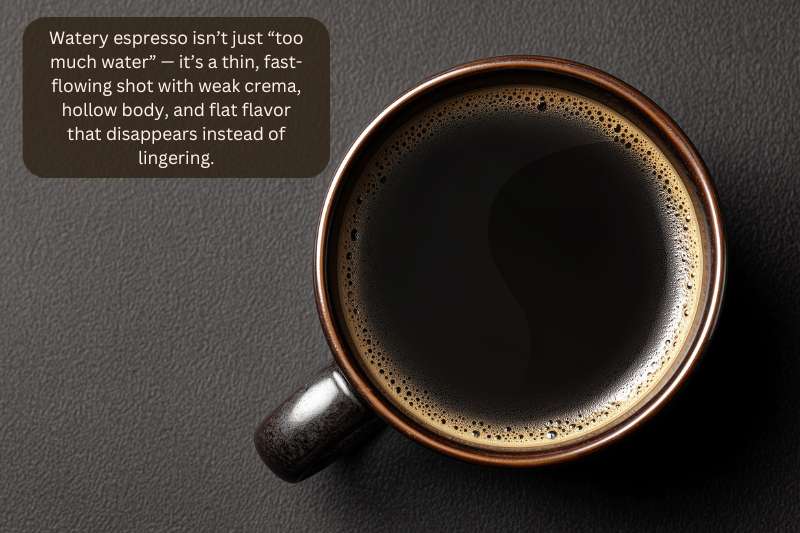
Thin body. Weak crema.
Good espresso has weight. Not syrup-thick, but it has presence. It coats your tongue a little. It lingers. Watery espresso just lands and disappears. No grip and texture. It feels hollow, like something’s missing.
And the taste is where it really shows.
Sometimes it’s sour. Sharp, underdeveloped, kind of edgy in a way that makes you squint. Not bright and lively. Just… unfinished. Other times it’s bitter, but weirdly thin at the same time. Like over-steeped tea that somehow still lacks strength. It’s hard to describe until you’ve had it. Then you immediately know.
Another thing I notice? The speed.
If the shot finishes in under 15–18 seconds, I already get suspicious. I’ve actually timed it before. Yes, with my phone out. When it gushes out pale and fast, almost watery from the very first second, that’s rarely a good sign. Instead of that slow, honey-like stream, it looks more like diluted coffee running through too easily.
And the aroma shifts too.
Espresso should smell warm, nutty, maybe a little sweet. When I lean in and mostly get steam. In other words, just heat and air. I know something’s off. It’s subtle, but once you’ve smelled a proper shot, the difference stands out.
Here’s something practical: Test it in milk.
If you pour the shot into steamed milk and the coffee completely disappears, that tells you everything. A solid espresso should still cut through milk. It should show up.
Now, one honest thing about super automatics.
They handle grinding, dosing, tamping, timing, and all the mechanics. That’s the whole appeal. Press a button, get espresso. But they don’t know your beans are old. They don’t know you switched to a lighter roast. They don’t notice when a setting got nudged slightly during cleaning.
They run the program you give them. So when espresso tastes watery, it’s usually not a big deal. It’s usually one small tweak away from being right again.
Want better espresso at home? A reliable machine makes all the difference.
8 Best Super Auto Espresso Machines (2026)
Want café-quality espresso at the push of a button? We break down the top super automatic machines — comparing espresso taste, milk systems, ease of use, and long-term value.
Fix #1 – Your Grind Is Too Coarse
First things first, start with the grind before anything else. Here’s what’s happening.
When the grind is too coarse, water flows through the coffee too easily. There’s barely any resistance. So instead of extracting those rich oils and deeper flavors, the water simply rushes through. Fast extraction equals under-extraction. And under-extraction is what gives you that watery and hollow shot.
If your espresso is finishing in under 15–18 seconds, that’s usually the giveaway. A healthier range is around 20–30 seconds. It doesn’t need to be exact. But if it’s gushing out quickly and looking pale from the start, the grind is probably too coarse.