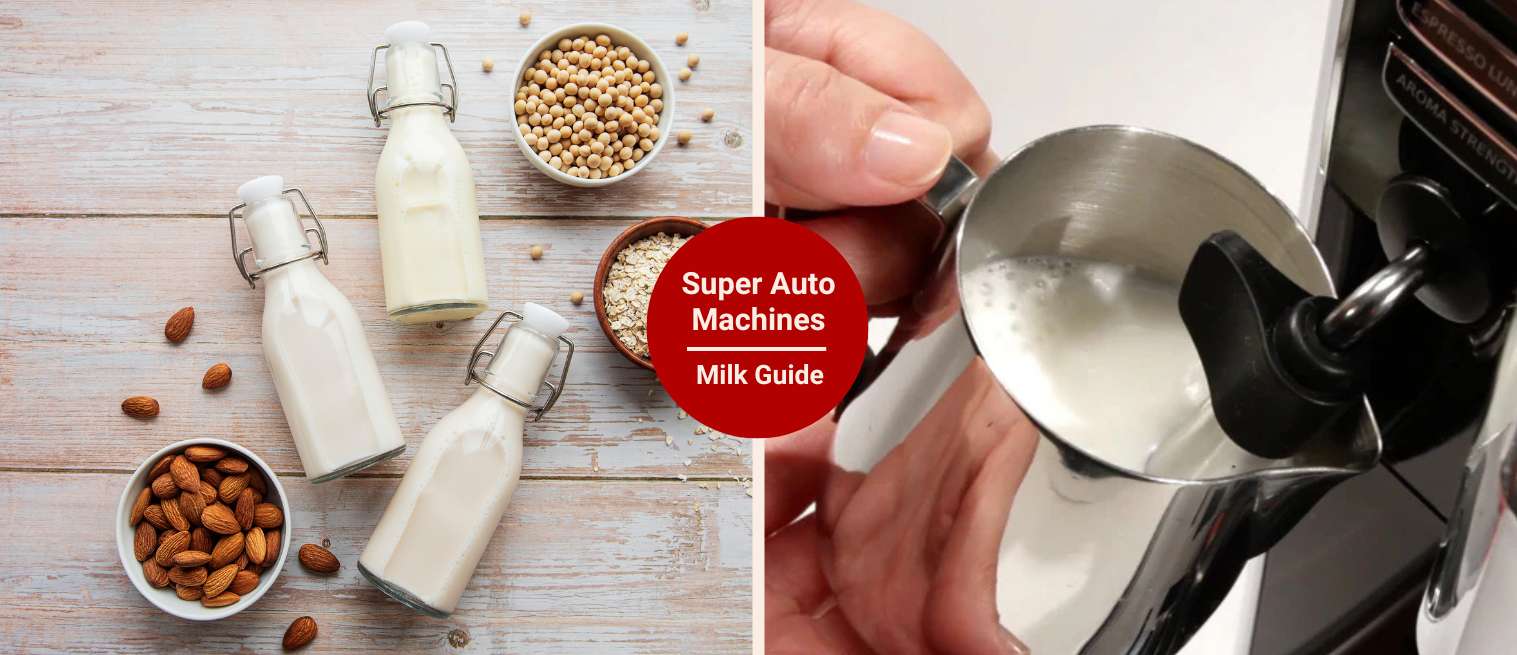
Can You Use Different Milks in Super Auto Machines?
Last updated on March 4th, 2026 at 12:04 pm
You finally unbox your first super-automatic espresso machine. It’s sleek, quiet, almost too smart. You press one button and it grinds, brews, and steams without you sweating.
And then it hits you. You don’t really like whole milk.
For some reason, that’s the first concern. Not grind size, brew temperature. Milk. You’re standing there staring at this beautiful machine thinking, Can I use almond? Oat? Soy? Or am I about to mess something up? That’s the problem.
Super automatics feel engineered. Precise. And when something feels technical, you hesitate to experiment. Especially with something that flows through tubes, froths automatically, and costs more than your first laptop.
You don’t want to ruin the experience. You just want your latte to taste the way you want it.
That’s the agitation part nobody talks about. You buy the machine for convenience and customization and suddenly you feel limited by milk choices. Especially if whole milk isn’t your thing.
Here’s the good news.
Yes, you can use different milks with super automatic espresso machines. But… not all of them behave the same. Some foam beautifully, others split if overheated. Some taste amazing but need an extra cleaning discipline.
In this guide, you’ll learn what works, what’s tricky, what foams best, and how to get better results without overthinking it. So you can use the milk you prefer without second-guessing your machine every morning.
Quick Comparison Table
If you skimmed most of this (no judgment. I do it too), here’s the quick side-by-side view. This gives you a fast snapshot of how different milks behave in a super auto machine.
| Milk Type | Foam Quality | Creaminess | Flavor Impact | Best For |
|---|---|---|---|---|
| Whole Milk | Excellent, stable microfoam | High | Naturally sweet, balanced | Cappuccinos, latte art |
| 2% Milk | Very good, consistent | Medium | Clean, lighter finish | Everyday lattes |
| Oat (Barista) | Very good, smooth | Medium-High | Mild sweetness, smooth | Dairy-free lattes & cappuccinos |
| Almond (Barista) | Fair to good | Low-Medium | Light, nutty | Light milk drinks |
| Soy | Good (temp sensitive) | Medium | Slight bean note | Vegan cappuccinos |
| Coconut | Low, airy | Low | Strong, tropical | Flavor-focused drinks |
| Lactose-Free | Very good | High | Slightly sweeter dairy | Sensitive stomach, classic drinks |
Notes:
If you want the safest bet, go with whole milk or barista oat milk. They’re the most forgiving and produce the most reliable foam.
If you’re experimenting, remember this: protein stabilizes foam, fat adds creaminess, and temperature can make or break plant-based milks. Most “bad foam” problems aren’t machine failures; they’re milk chemistry.
Want better espresso at home? A reliable machine makes all the difference.
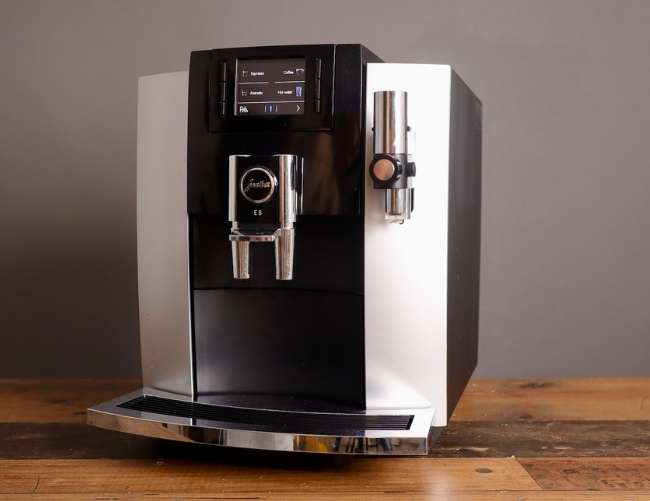
8 Best Super Auto Espresso Machines (2026)
Want café-quality espresso at the push of a button? We break down the top super automatic machines — comparing espresso taste, milk systems, ease of use, and long-term value.
Do Super Automatic Machines Support All Milk Types?
Short answer? Yes.
Long answer? …It depends what you expect.
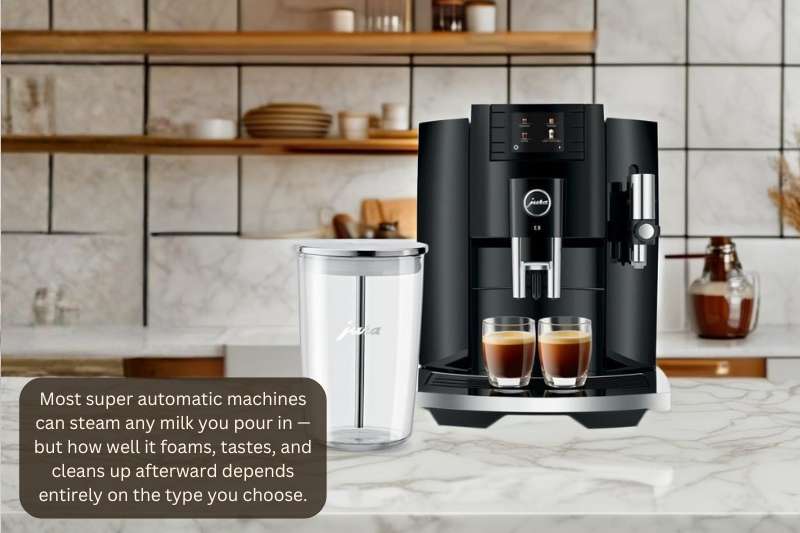
Here’s the truth: most super automatic machines will work with any liquid milk you pour into the container. Whole, 2%, almond, oat, soy, lactose-free, the machine doesn’t care. It pulls milk in, injects steam, pushes it out. Mechanically, it’s fine.
But texture? That’s a different story.
Milk foam is mostly about protein and fat
Protein traps the air bubbles. Fat makes it creamy and stable. Whole milk has both in a nice balance, which is why it’s so forgiving. You can slightly overheat it and it still looks decent.
Plant-based milks are trickier
Some of them have lower protein content. Some have added stabilizers. Some split if overheated. Automatic milk systems are also more sensitive than manual steam wands. With a manual wand, you can adjust the angle, depth, and sound as you feel. With a super automatic? It’s preset. Same pressure and timing.
So small differences in milk composition show up more clearly.
I learned this after testing three different oat milks back to back. With the same machine and settings. One foamed beautifully, producing airy bubbles. Meanwhile, the other barely thickened at all. Took me about two mornings to figure out it wasn’t the machine… it was the formula.
And cleaning matters more than people think.
Plant-based milks, especially oat, can leave slightly thicker residue inside the milk lines. If you don’t rinse right away, it builds up faster than regular dairy.
So yes, your super auto machine supports different milk types. The real question isn’t compatibility. It’s how well that milk behaves under automatic steaming.
Best Milks for Super Automatic Espresso Machines
If you want the least problems and the most best results, start here.
1 – Whole Milk (Best Overall Performance)
I’ve tested a lot of milks in super auto machines. Oat, almond, soy, and even coconut once that was interesting. But when I want a cappuccino that just works? I go back to whole milk.
There’s a reason cafés still default to it.
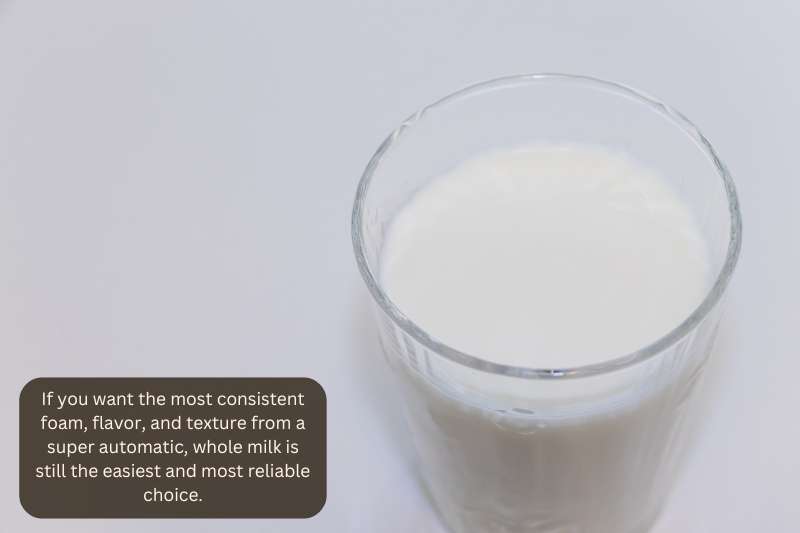
Whole milk gives you that creamy, glossy microfoam without fighting the machine. The texture feels thicker on the tongue. When it pours into espresso, it blends rather than sitting on top as a separate layer.
And the taste? There’s a natural sweetness in whole milk that complements espresso beautifully. It softens bitterness without erasing character. A medium roast especially tastes balanced and creamy all at once.
Foam stability is where whole milk really wins.
You can slightly overheat it and it still behaves. You can use the automatic frother without adjusting ten settings. It’s forgiving. For latte art? It’s still the easiest to control. Even with automatic systems, the foam density tends to be tighter and more uniform.
Why it works?
It’s simple science, honestly. Whole milk has a higher fat content along with solid protein structure. Protein traps the air bubbles. Fat adds body and smoothness. Together, they stabilize the foam so it doesn’t collapse immediately.
If you’re troubleshooting milk texture in your super automatic espresso machine, whole milk is the baseline. If it doesn’t foam well with whole milk, the issue probably isn’t the milk. It’s the machine or the settings.
2 – 2% Milk (Balanced Option)
If whole milk feels too rich for you or you prefer something lighter, 2% milk is a good middle ground.
Usually, people expect the foam to fall apart or feel thin in my super-automatic espresso machine. But it doesn’t. The texture is slightly lighter, sure. You notice it mostly on the first sip. Whole milk wraps around the espresso like a blanket. 2% feels a bit more streamlined. Cleaner finish. Still creamy but not as dense.
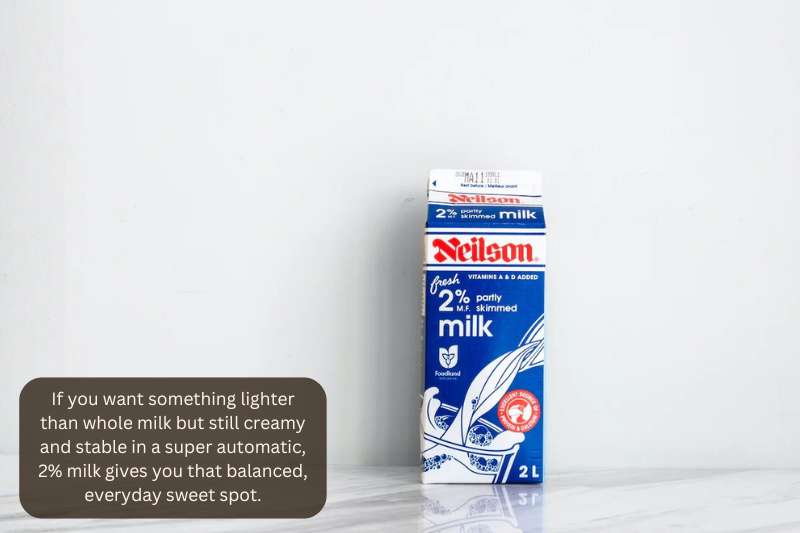
Foam stability is surprisingly good.
I’ve run side-by-side cappuccinos, one with whole, one with 2%, and unless you’re really paying attention, the difference isn’t dramatic. The microfoam holds together well. No giant bubbles forming at the top or collapsing layer after thirty seconds.
For everyday lattes, I actually think 2% makes a lot of sense.
If you’re drinking one or two milk drinks daily, the slightly lighter mouthfeel keeps things from feeling too rich. Especially with medium-dark roasts. The espresso still comes through clearly instead of being fully softened by fat.
There’s also something practical about it.
Super automatic machines are pretty consistent with 2% milk. It behaves predictably. You don’t usually have to tweak temperature or foam settings.
And taste-wise? It’s balanced. Not overly sweet like some lactose-free versions. Not overly heavy. Just… neutral in a good way.
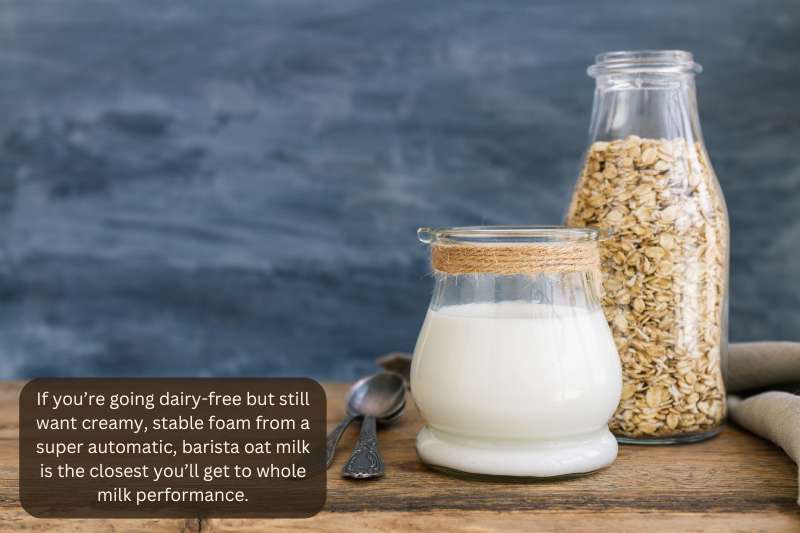
3 – Barista Oat Milk (Best Dairy Alternative)
The first time I tried oat milk in my super automatic, I was skeptical. Almond milk had already betrayed me with giant, soapy bubbles and foam that vanished in seconds. So I wasn’t expecting miracles. But barista oat milk surprised me.
Not regular oat milk. That’s important. The carton actually said “Barista” on it, and I almost rolled my eyes at the marketing. Then I frothed it.
The foam was… stable. Not identical to whole milk, but close enough that I paused and looked at it. The texture felt creamy instead of airy. When I poured it over espresso, it blended smoothly instead of separating into layers.
And the taste?
There’s a mild sweetness to oat milk that works well with espresso. Especially medium roasts. It softens sharp edges without making the drink taste sugary. The first latte I made with it had this slightly toasted, almost cereal-like note.
Now, here’s the catch.
If you grab a standard oat milk, results can vary a lot. I once tried three brands in a week. One foamed beautifully and turned into large bubbles. One barely thickened at all.
The difference? Stabilizers.
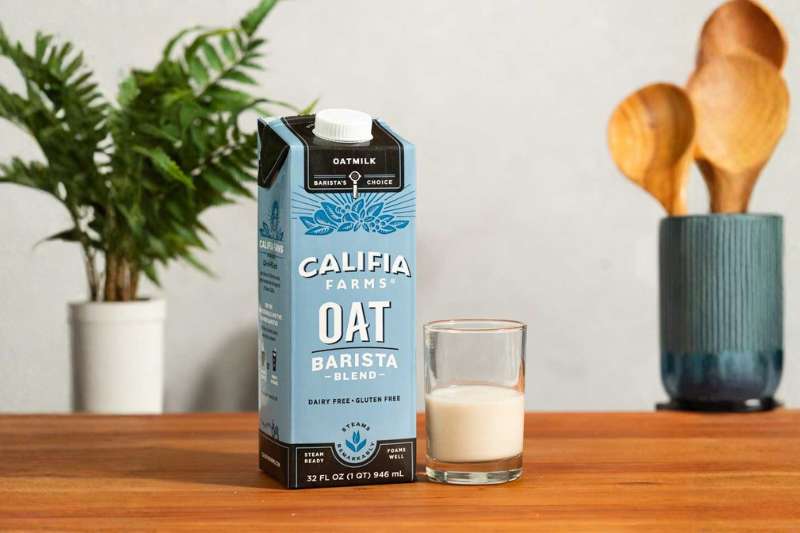
Barista versions usually include added emulsifiers and proteins that help trap air and create more consistent microfoam. That’s why they perform better in automatic milk systems, which don’t allow you to manually control steam angle or depth like a traditional wand.
In a super-automatic espresso machine, that consistency matters. You’re relying on preset frothing cycles. So having milk that cooperates with that system makes life easier.
Cleaning-wise, oat milk leaves a slightly thicker residue than dairy milk. Nothing dramatic, but I rinse immediately after each use.
If you’re dairy-free and want something that still feels indulgent? Barista oat milk is probably your safest bet.
Milks That Can Be Tricky
Some milks technically work in a super auto machine. But they make you work harder for a good result.
Almond Milk
Almond milk was my first “this should be fine” experiment. It wasn’t fine.
The foam came out with these big, airy bubbles like dish soap foam. It looked impressive for about ten seconds, then collapsed into a thin layer. The body felt light, almost watery, which is ironic when you’re trying to avoid a watery latte.
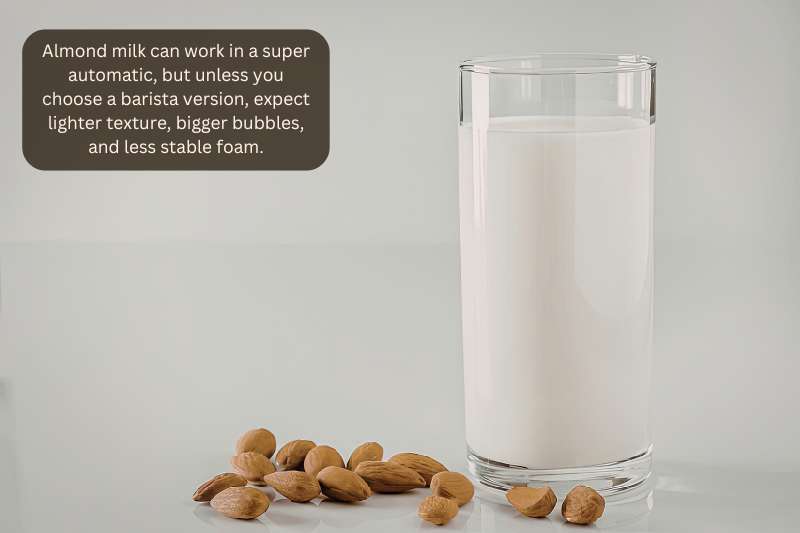
Now, to be fair, barista versions behave better. They’re thicker and usually have added stabilizers. But standard almond milk? Expect larger bubbles and less stable microfoam.
Taste-wise, it’s subtle and nutty, which can be nice. But texture matters more than people realize.
Soy Milk
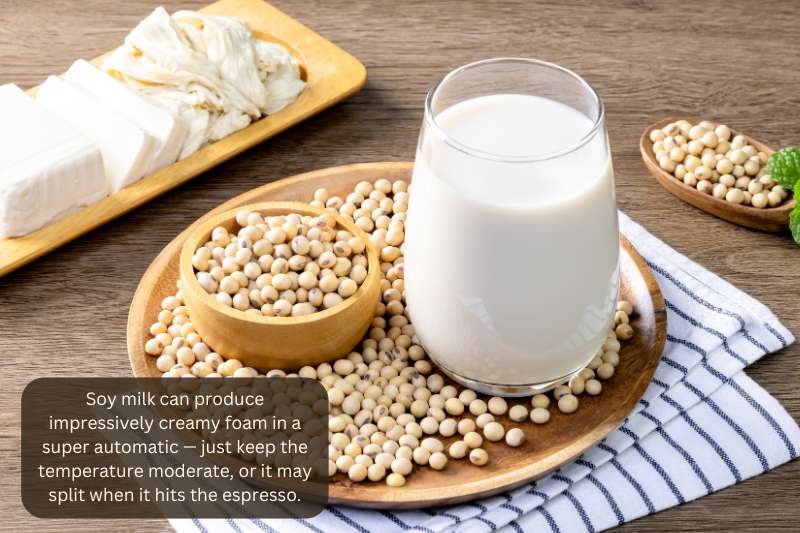
It can actually foam pretty well. I’ve had soy cappuccinos that looked almost identical to dairy. The texture can be thick and creamy.
But here’s the catch: temperature.
If you overheat soy milk, it can split. I’ve watched it happen. The surface looks slightly curdled, especially when it hits acidic espresso. It doesn’t taste terrible, but visually? Not great. So, keep the temperature moderate and it should work much better.
Coconut Milk
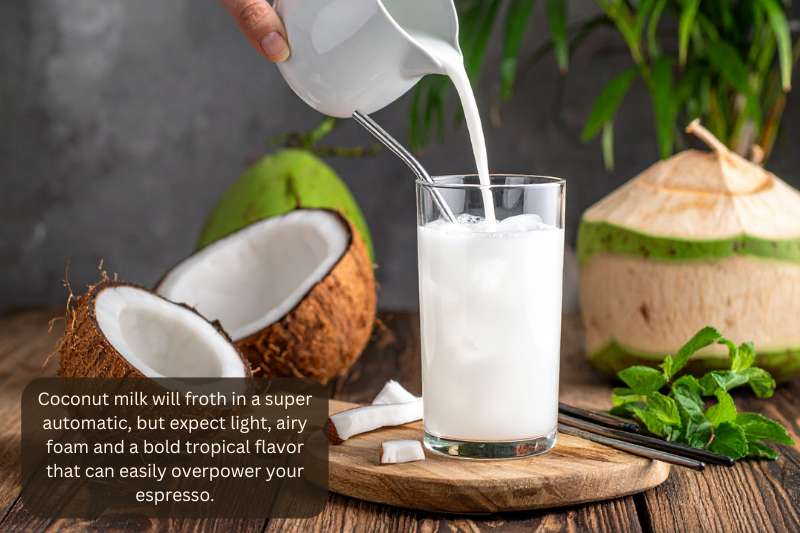
Foam tends to be very thin. Almost airy, with very little structure. You’ll get bubbles but not that tight, velvety microfoam people expect from a cappuccino. It feels lighter, almost frothy rather than creamy.
And the flavor?
Strong. Tropical. Slightly sweet. Definitely, very noticeable.
I tried it once with a darker roast espresso thinking it would add a subtle twist. It didn’t. The coconut completely dominated the cup. It smelled amazing but the balance was off. The espresso took a back seat.
Now, if that’s what you’re going for, great. Coconut milk can be fun when you lean into it instead of a milk substitute. In fact, I have a full coconut latte recipe here if you want to experiment properly.
Lactose-Free Milk
Lactose-free milk foams almost as well as regular dairy. The protein structure is still there, so the texture is stable. The main difference is taste. It’s slightly sweeter because the lactose is broken down into simpler sugars.
If you’re sensitive to lactose but still want reliable foam, this is typically a safe bet.
Last Thoughts
If you’ve tried different milks with your super auto and had a weird result, splitting, thin foam, clogged lines, or strange flavor, drop a comment below. Tell me what machine you’re using and what milk you tested. Sometimes one small detail makes all the difference.